

Qi and Blood running low
The core pattern looks pale and tired, maybe a bit lightheaded if you get up too fast.


Traditional Chinese herbal formula
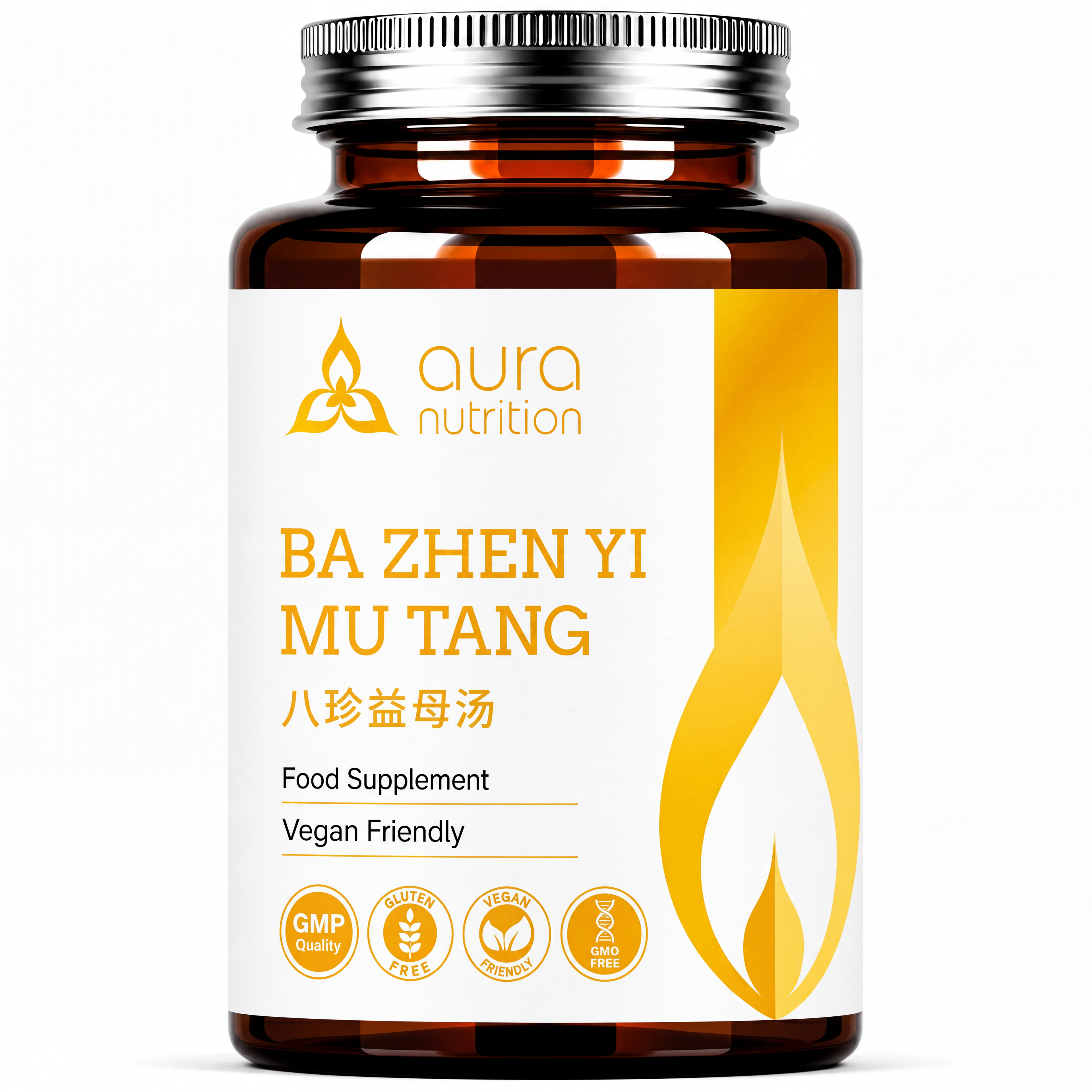
八珍益母汤 · Eight Treasures with Motherwort · also known as Ba Zhen Yi Mu Wan
Take Ba Zhen Tang, the Eight Treasures, and add a generous helping of motherwort. That's this formula. Herbalists used it for women who felt drained of both Qi and Blood, especially around the monthly cycle, when the cycle itself seemed sluggish.
Nine herbs, with motherwort as the largest by far, then dong quai, rehmannia and ginseng. Made into 5:1 tablets, six a day, so one bottle lasts ten days. Explore the formula
Couldn't load pickup availability
Verified Loox reviews
★★★★★
"Another great product"
Kevin S. · Video review · Verified buyer★★★★★
"The staff are kind, helpful & actually listen & care for their customers wellbeing. The products are great & I experience positive results taking Jia Wei Xiao Yao San & Geng Nian for my moody, sad, depressed, brain fogged,…"
★★★★★
"I started using these alongside acupuncture to help with neuropathic migraine pain after reacting to prescription medication. After 2 months I have seen a great improvement in my overall health and can't recommend them enough."
★★★★★
"I've had a very positive experience with Xiao Yao San. I started taking it during a period when I was experiencing hormonal changes, mood swings and emotional ups and downs. Since taking it, I've noticed that I feel more balanced…"
★★★★★
"Slowly introduced. No obvious immediate effects. After 2 weeks. I realise life is calmer. Anxiety lessened, joy is there. I feel like me. I will continue. I am taking 2 in the morning and 2 in the evening. I will increase to the…"
★★★★★
"I run The Menopause Herbalist - an on-line service supporting women in navigating peri-menopause and menopause symptoms. I recommend Aura Nutrition to all my patients as I have observed over the last few years the significant…"
First came the Eight Treasures. It's two older formulas stuck together, if we're honest, with the Four Gentlemen (Si Jun Zi Tang) bringing the Qi side and the Four Substances (Si Wu Tang) bringing the Blood. When exactly somebody joined them up is a bit fuzzy, but most of the textbooks on our shelf say the Ming dynasty, some time in the 1500s. Eight herbs, two old friends, one pot.
Who added the motherwort? Usually it's credited to Zhang Jingyue, the Ming physician whose enormous Jing Yue Quan Shu came out in 1624. He had plenty to say about women's health, and Ba Zhen Yi Mu Wan went on to become one of the standard pills for it in China.
Motherwort's Chinese name, Yi Mu Cao, means 'herb that benefits mothers', a reputation it's had right back to the Shen Nong Ben Cao Jing. And funnily enough, the old European name says much the same thing. Great minds, and all that.
In Chinese medicine
Ask any Chinese medicine practitioner and they'll tell you Qi and Blood come as a pair, a bit like tea and biscuits. Qi's what pushes the Blood round, Blood's what gives the Qi something to hold on to, and if one gets low the other tends to follow it down. The old books call the result Qi and Blood deficiency. Think pale, flat, and a touch lightheaded when you get up off the sofa too fast.
Then there's the Liver, which is said to store Blood and let it out for the monthly cycle. Herbalists thought that if the stores were thin, the cycle had less to work with and might show up late, light or sluggish, with a dull, dragging feel to it. A bit like trying to run a bath with rubbish water pressure.
Ginseng, white atractylodes, poria and liquorice are the Qi builders. Rehmannia, dong quai, white peony and Szechuan lovage do the same for Blood. And motherwort, at double the dose of anything else in here, keeps that Blood on the move so it doesn't pool. Building and moving at the same time. Rather neat, we think.
The Five Elements
The Liver stores the Blood and it belongs to Wood, the element of spring and steady growth. Picture a young tree, which needs water at its roots before it can push out any new leaves.
Spring
Wood's season, all new growth and sap rising.
Liver
It's said to store the Blood and release it each month, and this formula both fills the store and keeps it flowing.
Green
Wood's colour, and motherwort's a properly leafy, square-stemmed green herb.
Sour
That's Wood's taste, and white peony brings a touch of it here.
Anger
Or frustration. Herbalists say a Liver that's short of Blood tends to make for a shorter temper too. Sound familiar?
Traditional use
Here's where herbalists have historically reached for it. It's traditional use we're sharing, which isn't the same thing as a medical claim.
The core pattern looks pale and tired, maybe a bit lightheaded if you get up too fast.
This is its classic use, for when the monthly cycle seems late, light or slow off the mark.
Eight Treasures formulas have long been a herbalist's go-to when someone needs building back up.
Generation after generation, it's stayed one of the most familiar women's formulas in Chinese pharmacies.
This section describes traditional use in Chinese herbal practice. Ba Zhen Yi Mu Tang is a food supplement and is not intended to diagnose, treat, cure or prevent any disease.
Inside the formula · Ingredients
Arranged like a Chinese royal court, with motherwort as the clear chief. Amounts are per daily serving of 6 tablets.
Chief
Motherwort gets the biggest amount, twice any other herb, and herbalists use it to keep Blood moving through the cycle. Herb Glossary
Ministers
Dong quai and rehmannia build the Blood, and ginseng builds Qi so there's actually something to push that Blood along. Herb Glossary
Assistants
White peony and Szechuan lovage round off the Blood side. White atractylodes and poria? They look after the Spleen, which is where Qi and Blood get made in the first place. Herb Glossary
Envoy
Liquorice harmonises the lot, same as in so many other formulas. Herb Glossary
Inactive ingredients: Cassava starch, Hypromellose, Magnesium stearate, Polyethylene glycol, Talc.
These are used in very small amounts to form and coat the tablets. They don't add to the formula itself.
How to take
Tablets with water.
Tablets with water.
Most people take a formula for several weeks.
Always follow the label. If you take any medication, are pregnant or breastfeeding, please speak to your GP or pharmacist before use.
Choosing between them
| Compare | Ba Zhen Yi Mu Tang | Ba Zhen Tang |
|---|---|---|
| First recorded | Ming dynasty, early 1600s | Ming dynasty, 1500s |
| The idea | Build Qi and Blood, and keep Blood moving | Build Qi and Blood |
| Herbs | 9, led by motherwort | 8, led by rehmannia and dong quai |
| Character | Building with a gentle push | Purely building and balanced |
| Often chosen when | The cycle feels sluggish as well as the energy | General tiredness and paleness are the main thing |
You've got ginseng, white atractylodes, poria and liquorice for Qi, plus rehmannia, dong quai, white peony and Szechuan lovage for Blood. Add motherwort and that's nine, so yes, the maths is a bit generous.
Herbalists go for the motherwort version when the monthly cycle's part of the picture. If it's more of a general tiredness thing, plain Ba Zhen Tang is the usual choice.
Lots of women take it right through the month. That said, herbalists often focus on the days just after a period, when Blood's said to need rebuilding.
No, sorry. Motherwort (yi mu cao, which rather ironically translates as 'benefit mother herb') has a long history of being used to move Blood in the womb, and that's exactly why we'd say steer clear if you're pregnant or trying to conceive. Breastfeeding? Then have a word with your GP before you start.
Possibly. We'd be cautious with dong quai and ginseng if you're on warfarin or another blood thinner, and ginseng can nudge blood sugar about, which matters if you're on diabetes medication. For anything else you take day to day, your GP or pharmacist is the person to ask (they're usually happy to, we promise).
Six a day, so three in the morning and the other three at night. That gets you ten days out of a 60-tablet bottle, if you were wondering.
Related formulas
Verified Loox reviews
Food supplements should not be used as a substitute for a varied, balanced diet and a healthy lifestyle. Not intended to diagnose, treat, cure or prevent any disease. Keep out of reach of children.


