


Blood stasis in the channels
The pattern Wang Qingren wrote it for: Blood that's slowed and stuck along the channels of the body.


Traditional Chinese herbal formula
身痛逐瘀汤 · Hookweed & Lovage · also known as
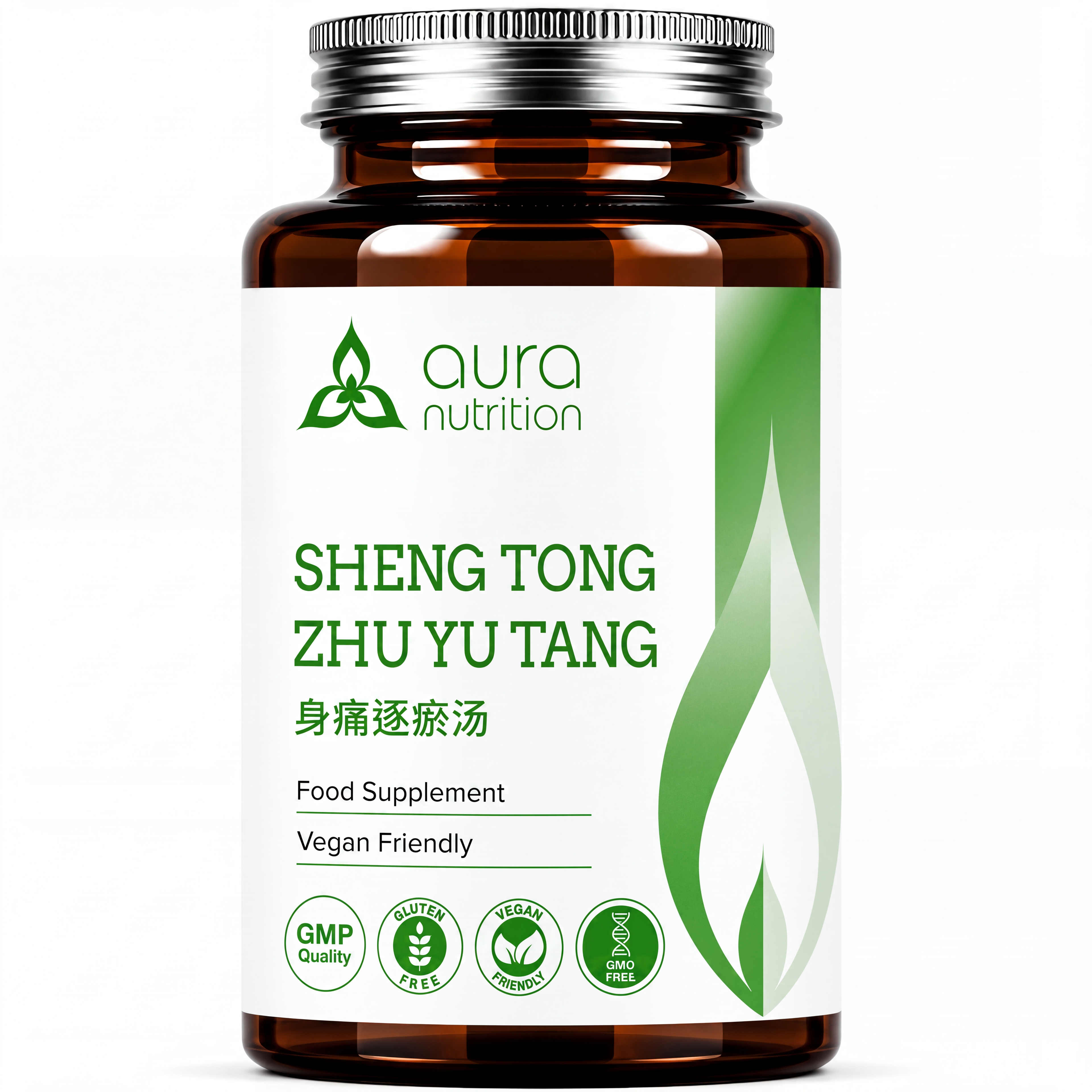
Shen Tong Zhu Yu Tang comes from Wang Qingren, the Qing dynasty doctor who built a whole career around one idea: Blood stasis. The name means 'drive out stasis from the aching body', and he wrote it for stiff, achy, stuck-feeling days that other formulas hadn't shifted.
Eleven herbs, led by peach kernel, safflower, dong quai and Sichuan lovage, with cyathula (hookweed) to take things down to the legs. Made into 5:1 tablets. Six a day, so a bottle lasts ten days. Explore the formula
Couldn't load pickup availability


Verified Loox reviews
★★★★★
"Have been taking Shen Tong for about 12 years directed by my TCM practitioner - first as pills, then powder, and now back to pills. To be honest I prefer powder - for me easier to swallow and more economical. Shen Tong has proved…"
Ms D. · Video review · Verified buyer★★★★★
"Thanks"
★★★★★
"Quick and easy ordering process! Taste fine and does the job perfectly would recommend!"
★★★★★
"The staff are kind, helpful & actually listen & care for their customers wellbeing. The products are great & I experience positive results taking Jia Wei Xiao Yao San & Geng Nian for my moody, sad, depressed, brain fogged,…"
★★★★★
"I started using these alongside acupuncture to help with neuropathic migraine pain after reacting to prescription medication. After 2 months I have seen a great improvement in my overall health and can't recommend them enough."
★★★★★
"I've had a very positive experience with Xiao Yao San. I started taking it during a period when I was experiencing hormonal changes, mood swings and emotional ups and downs. Since taking it, I've noticed that I feel more balanced…"
Wang Qingren was an unusual figure. In the late 1790s, during an epidemic, he went to look at the remains of children who had died, because he wanted to see the organs for himself rather than trust the old diagrams. He spent decades on it. The result was the Yi Lin Gai Cuo, 'Correcting the Errors in the Forest of Medicine', published in 1830.
Some of his anatomy was wrong too, as later critics loved to point out. But his formulas were a hit. He wrote a series of 'zhu yu' (drive out stasis) recipes, each aimed at a different part of the body. Xue Fu Zhu Yu Tang for the chest, Ge Xia Zhu Yu Tang for under the diaphragm, and this one, Shen Tong Zhu Yu Tang, for aches through the body and limbs.
Our version differs from Wang's original in a few places. It's plant-only, so his earthworm and flying-squirrel droppings (yes, really) are out. Red sage, gentian and siler stand in for a couple of the other herbs. The core idea of moving the Blood through the channels stays exactly the same.
In Chinese medicine
Wang Qingren's big insight, as he saw it, was that a lot of stubborn aches came down to Blood stasis. Blood that should flow freely through the channels had slowed and stuck. When that happens, the old texts say, the discomfort tends to be fixed in one place, sharp rather than dull, and worse at night.
He noticed that the usual wind-damp formulas for achy joints didn't always work. If the aches had been around a long time, he reasoned, the Blood had probably stalled as well. So he put Blood-moving herbs at the centre and kept a few wind-damp herbs around the edges.
Peach kernel, safflower, dong quai and Sichuan lovage are the Blood movers, and cyathula and myrrh carry that movement out into the limbs and joints. Siler and gentian deal with wind and damp. Then there's cyperus, which moves Qi (in this system, Blood follows Qi), and red sage chips in with more Blood-moving help. And liquorice, as usual, is the one stopping everybody else from squabbling.
The Five Elements
Chinese medicine has the Liver storing Blood and feeding the sinews (that's the old catch-all for your tendons and ligaments, all the stringy bits that let you bend), and both of those sit under Wood. Cut off the Blood supply to the sinews and, well, Wood goes stiff.
Spring
Wood's season. All that new growth depends on things flowing freely.
Liver
The Blood store, and in charge of the sinews. Stiffness and stuck Blood both lead back here.
Green
Wood's colour. Though with safflower and red sage in the mix, this formula's more red than green.
Sour
Wood's taste. Not a sour formula, honestly. It leans pungent and bitter, which is what moving herbs tend to be.
Anger
Wood's emotion. Herbalists say being stuck, in the body or in life, tends to make us tetchy.
Traditional use
This is how Shen Tong Zhu Yu Tang has been used traditionally. We're describing history and practice, not making any medical claims.
The pattern Wang Qingren wrote it for: Blood that's slowed and stuck along the channels of the body.
Herbalists chose it when aches felt fixed and sharp rather than heavy, and tended to linger.
For when an old wind-damp picture has dragged on so long the Blood has stalled too.
In the clinic it's often paired with acupuncture or tui na massage, the idea being you work on the same stuck channels from two directions at once.
This section describes traditional use in Chinese herbal practice. Shen Tong Zhu Yu Tang is a food supplement and is not intended to diagnose, treat, cure or prevent any disease.
Inside the formula · Ingredients
A busy court, with four Blood-movers in charge. Amounts are per daily serving of 6 tablets.
Chiefs
Peach kernel, safflower, dong quai and Sichuan lovage are Wang Qingren's go-to Blood-moving team. Herb Glossary
Ministers
Cyathula (hookweed) leads things downwards to the legs. Red sage and myrrh add more Blood-moving help. Herb Glossary
Assistants
Siler and gentian clear wind and damp from the channels. Cyperus moves Qi so the Blood can follow. Herb Glossary
Envoy
Liquorice harmonises and protects the Stomach from all that movement. Herb Glossary
Inactive ingredients: Cassava starch, Hypromellose, Magnesium stearate, Polyethylene glycol, Talc.
These are used in very small amounts to form and coat the tablets. They don't add to the formula itself.
How to take
Tablets with water.
Tablets with water.
Most people take a formula for several weeks.
Always follow the label. If you take any medication, are pregnant or breastfeeding, please speak to your GP or pharmacist before use.
Choosing between them
| Compare | Shen Tong Zhu Yu Tang | Tao Hong Si Wu Tang |
|---|---|---|
| First recorded | Qing dynasty, 1830 | Qing dynasty, 1700s |
| The idea | Move Blood through the channels and limbs | Nourish the Blood and move it |
| Herbs | 11, including cyathula, myrrh and siler | 6, including rehmannia and white peony |
| Character | Strongly moving | Nourishing as well as moving |
| Often chosen when | Aches feel fixed in the body and limbs | Blood stasis comes with Blood running low |
A Qing dynasty doctor who wanted to see human anatomy for himself, at a time when that was almost unheard of in China. He's best remembered for his Blood-stasis formulas, and this is one of the famous ones.
'Shen tong' is body ache, 'zhu yu' is to drive out stasis and 'tang' is decoction. So, a brew to drive stasis out of the aching body.
Most people do three with breakfast and three with tea in the evening. At six a day you'll be done with a bottle in ten days.
If you're pregnant, hoping to be, or breastfeeding, this really isn't one for you. Herbalists have never let a Blood-mover this punchy anywhere near a pregnancy. There's a long list of herbs in here that can affect clotting (peach kernel, safflower, dong quai, red sage and myrrh, to be exact), so we'd ask you not to take it alongside warfarin, aspirin or any other blood thinner, and to stop well ahead of any operation. The liquorice can raise blood pressure too. Heavy periods, or on any medication? Check with your GP first.
Yes. Wang Qingren's original includes earthworm and flying-squirrel droppings. Ours doesn't.
Hookweed is a name for cyathula (niu xi), the herb that takes the formula down to the legs, and lovage is Sichuan lovage (chuan xiong), one of its main Blood movers.
Related formulas
Verified Loox reviews
Food supplements should not be used as a substitute for a varied, balanced diet and a healthy lifestyle. Not intended to diagnose, treat, cure or prevent any disease. Keep out of reach of children.


