

Tired but wired
The classic match: a busy, fretful mind at night alongside a feeling of being worn thin.


Traditional Chinese herbal formula
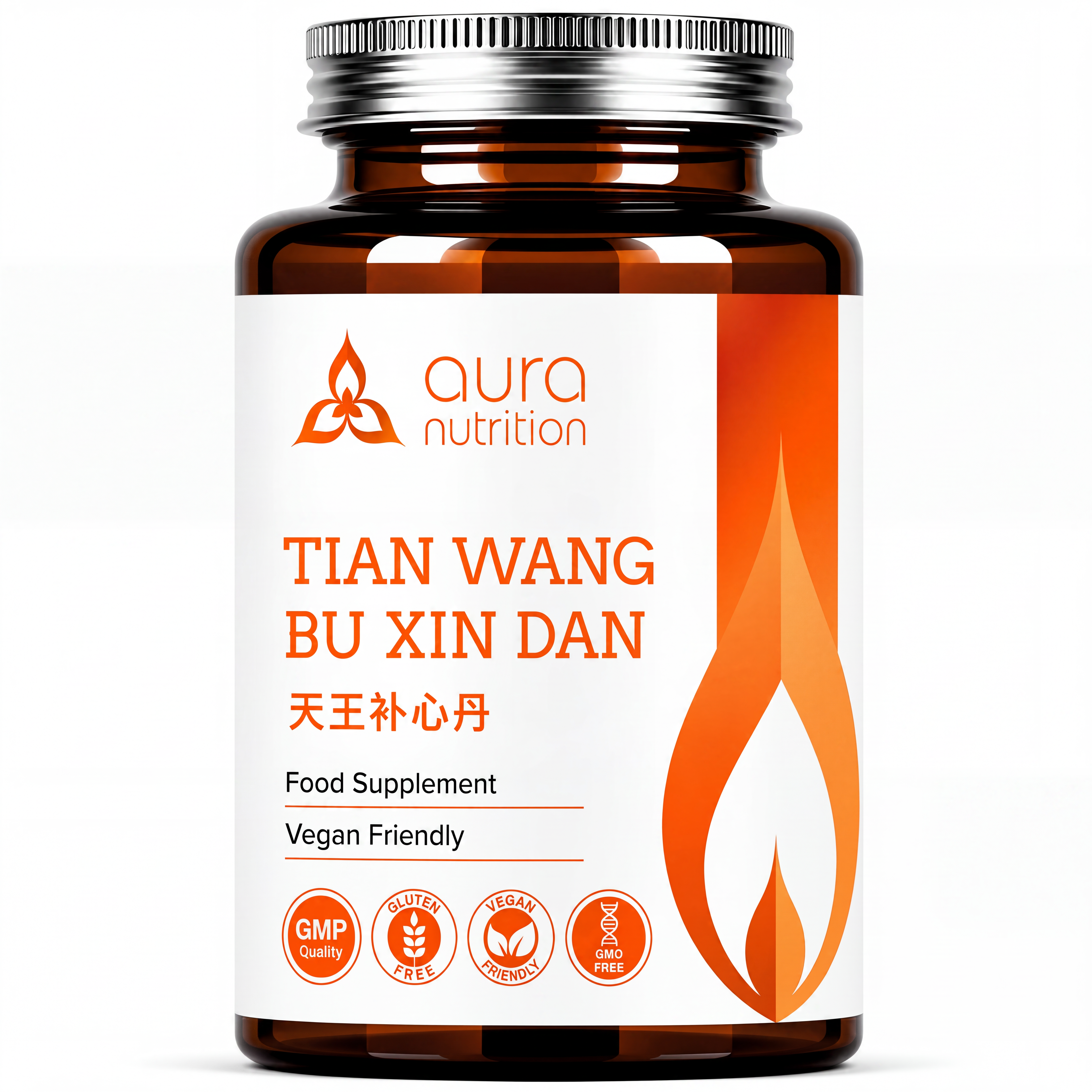
天王补心丹 · Emperor of Heaven's Heart Pill · also known as Heavenly Emperor's Pill to Tonify the Heart
A formula with a legend attached. Tian Wang Bu Xin Dan was traditionally chosen for the mind that's still racing at midnight, when you feel tired but wired, a bit dry and a bit too warm to drift off. In Chinese medicine terms, that's Heart and Kidney Yin running low.
Thirteen herbs, led by rehmannia with asparagus root, ophiopogon and dong quai. Made into 5:1 tablets. Six a day, and a bottle lasts ten days. Explore the formula
Couldn't load pickup availability
Verified Loox reviews
★★★★★
"Feels potent!"
Thomas A. · Video review · Verified buyer★★★★★
"My Chinese therapist recommended and I have been taken for 4 mouths, I feel the difference, sleeping better and less anxious. The pills are each to swallow as well, and well-packaged."
★★★★★
"Good service great product!"
The story goes like this. A Buddhist monk had studied and chanted so hard that he'd worn himself out completely. One night the Tian Wang, a heavenly king, appeared to him in a dream and gave him this recipe. Hence the name: the Heavenly King's pill to tonify the Heart. Lovely story. Probably not how it happened.
What we can say is that it turns up in Ming dynasty books. Most Chinese textbooks cite the version in Xue Ji's annotated edition of Fine Formulas for Women from the 1500s, and a closely related version appears in Hong Ji's She Sheng Mi Pou of 1638.
Old versions were rolled in cinnabar, a mercury mineral that nobody would use now. Ours, like every modern version, leaves it out. Our recipe also uses silk tree bark and he shou wu where the classical one has two seeds, sour jujube and arborvitae.
In Chinese medicine
Right, Fire and Water. The Heart gets Fire in Chinese medicine and the Kidneys get Water, and we always explain it to customers with a saucepan: flame underneath, water in the pan, neither allowed to win. Now do months of late nights and early starts. The theory says your Kidney Yin slowly boils off, there's less water up top to keep things cool, and the Heart ends up running hot.
Why care? Well, the Heart is meant to house the Shen (roughly, your Spirit), and the old idea is that it can't settle in a Heart that's gone hot and dry. So what you'd hear described in clinic is a mind that's whirring away at 2am, a mouth like sandpaper, perhaps a fluttery chest or a couple of little ulcers on the tongue, and a warmth that sneaks up in the evenings. Textbooks file it under Heart and Kidney Yin deficiency.
Rehmannia, asparagus root, ophiopogon and figwort root are the cool, moist crowd, there to nourish Yin. Dong quai and red sage look after the Blood. For settling the Spirit you've got polygala, poria, schisandra and silk tree bark, and platycodon carries the lot up to the Heart. That's the logic, anyway.
The Five Elements
The Heart belongs to Fire. A good fire is warm, bright and steady. Without enough Water to balance it, it flickers and flares, which is just the picture this formula was built around.
Summer
Fire's season, long and bright. Late nights are easy, rest is harder.
Heart
Said to house the Shen, the Spirit. Paired with the Small Intestine.
Red
Fire's colour. Red sage root, one of the herbs here, takes its name from its red roots.
Bitter
Bitter is said to cool and calm Fire. Figwort and red sage both bring it.
Joy
Fire's emotion. In balance it's warmth and good cheer. Overdone, it's excitement that won't switch off.
Traditional use
Here's how herbalists have used it traditionally. Read this as history and tradition, please, not a claim about what it'll do for you.
The classic match: a busy, fretful mind at night alongside a feeling of being worn thin.
Fitting, given the legend. Herbalists chose it for people who'd been studying or working all hours.
Used when Yin deficiency showed as a dry mouth, warm palms and heat that rose in the evening.
The standard choice for Heart and Kidney Yin deficiency in Chinese medicine theory.
This section describes traditional use in Chinese herbal practice. Tian Wang Bu Xin Dan is a food supplement and is not intended to diagnose, treat, cure or prevent any disease.
Inside the formula · Ingredients
Chinese formulas are built like a royal court, with a chief herb in charge and the others in support. Amounts are per daily serving of 6 tablets.
Chief
Rehmannia nourishes Yin and Blood and is said to cool the Heart. There's twice as much of it as anything else. Herb Glossary
Ministers
Asparagus root and ophiopogon (little pale tubers, slightly sweet and chewy) bring more cooling moisture. Dong quai and he shou wu are along for the Blood side of things. Herb Glossary
Assistants
It's a crowded bench, this one. You've probably seen a silk tree without knowing it (those fluffy pink pompom flowers you get in Mediterranean gardens), and its bark sits with polygala, poria and schisandra on the calming-the-Spirit side. Figwort's here for its cooling. Red sage is the one that moves Blood, and there's just a pinch of ginseng to keep Qi from flagging. Herb Glossary
Envoy
Platycodon is traditionally said to guide the other herbs upwards to the Heart. Herb Glossary
Inactive ingredients: Cassava starch, Hypromellose, Magnesium stearate, Polyethylene glycol, Talc.
These are used in very small amounts to form and coat the tablets. They don't add to the formula itself.
How to take
Tablets with water.
Tablets with water.
Most people take a formula for several weeks.
Always follow the label. If you take any medication, are pregnant or breastfeeding, please speak to your GP or pharmacist before use.
Choosing between them
| Compare | Tian Wang Bu Xin Dan | Gui Pi Tang |
|---|---|---|
| First recorded | Ming dynasty | Song dynasty, 1253 |
| The idea | Nourish Heart and Kidney Yin and calm the Spirit | Build up the Spleen to nourish Heart Blood |
| Herbs | 13, including rehmannia, asparagus root and ophiopogon | 12, including astragalus and longan fruit |
| Character | Cool and moistening | Warm and nourishing |
| Often chosen when | A restless mind comes with dryness and warmth at night | A restless mind comes with tiredness and a poor appetite |
A practitioner would call it Heart and Kidney Yin deficiency. In normal words? Lying awake with your thoughts going round, feeling a bit parched and warm and worn thin. It's a food supplement, mind, so it isn't meant to address any medical condition.
No. Old recipes rolled the pills in cinnabar, a mercury-based mineral. Modern makers leave it out, and so do we.
Three in the morning and three in the evening. A bottle of 60 lasts ten days.
Please check with your GP before you start, and if you're pregnant or breastfeeding, only take it if they've said yes. We'd also point out the he shou wu. The UK MHRA has warned it can, rarely, cause liver problems, so if your liver's given you bother before, skip this one, and if you spot yellowing skin, dark wee or tummy pain, stop and get checked. Last thing: with dong quai and red sage in the mix, it's a no if you're on warfarin or another blood thinner.
We get asked this a lot, since they're both for a Heart that won't switch off! Honestly the quickest way to tell them apart is to ask whether you feel hot and dry or just shattered. Hot and dry, and a herbalist's hand goes to Tian Wang Bu Xin Dan (the cooler, moister one). Shattered, pale and off your food, it's more often Gui Pi Tang, which is warmer. Still torn? Drop us a line.
Who knows. It's a legend, and a nice one. The formula itself is very much real, and it's been in Chinese clinics for centuries.
Related formulas
Verified Loox reviews
Food supplements should not be used as a substitute for a varied, balanced diet and a healthy lifestyle. Not intended to diagnose, treat, cure or prevent any disease. Keep out of reach of children.


