

A cold-natured cycle
For a cycle that, in the old language, runs cold. Picture a tight, chilly lower belly that's happiest with a hot-water bottle tucked against it.


Traditional Chinese herbal formula
温经汤 · Warm the Menses · also known as
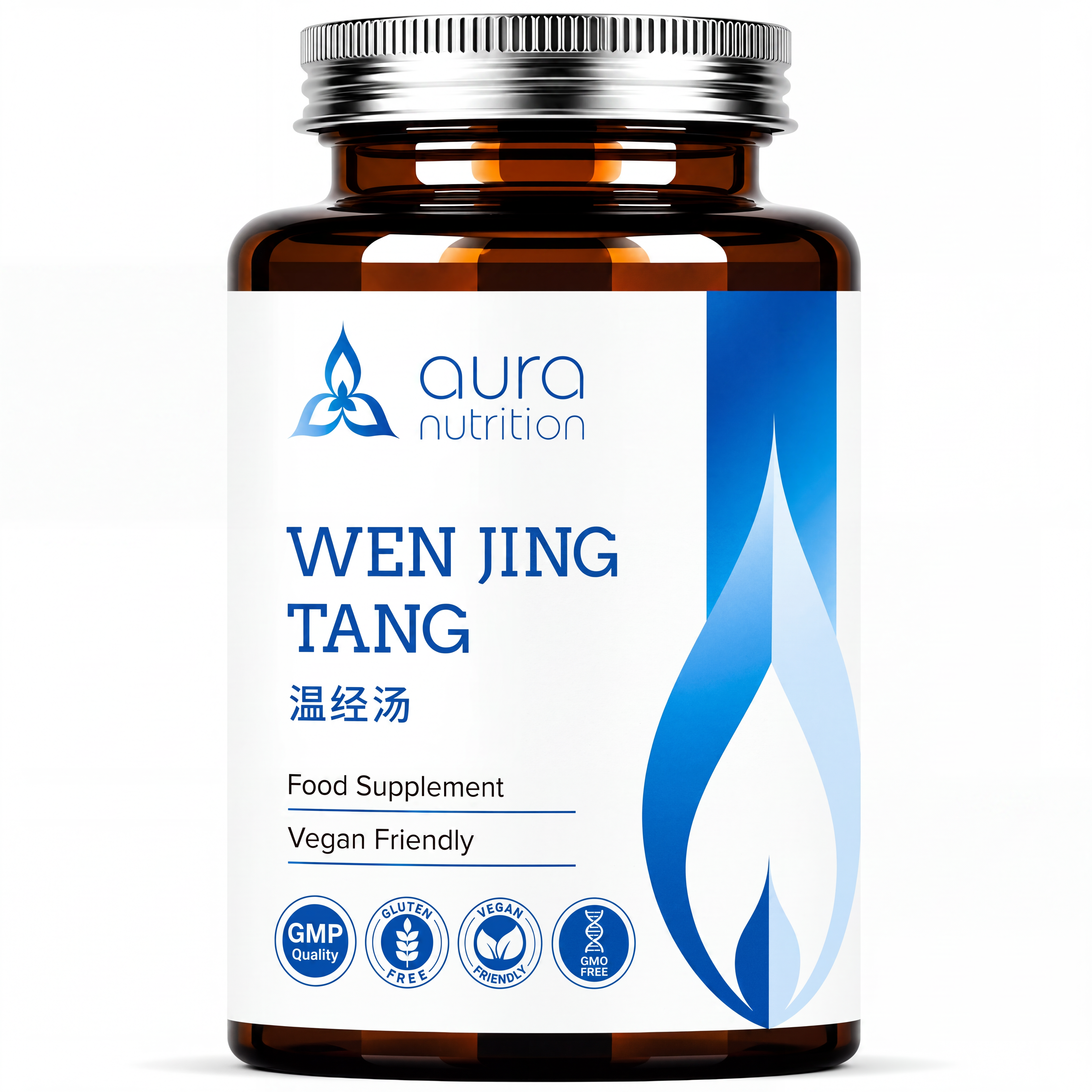
Wen Jing Tang means 'warm the channels' or 'warm the menses', and that's the whole idea. It's another formula from Zhang Zhongjing's Golden Cabinet, around 200 AD, and herbalists have used it for centuries when a woman's cycle seemed to run cold, sluggish and a bit depleted.
Eleven herbs, with warming cinnamon bark and sharp-leaf galangal fruit alongside Blood herbs like dong quai and white peony. Made into 5:1 tablets. Six a day, and a bottle lasts ten days. Explore the formula
Couldn't load pickup availability
Verified Loox reviews
★★★★★
"Recommended these by my acupuncturist for better hormone balance and liver detoxification. I felt better within a few of days of using the Wen Jin Tang - uplifted, more relaxed, happier, sleeping better. Highly recommend this…"
★★★★★
"I bought Wen Jing Tang since I started to bleed between periods. Quite amazed to find that bleeding stopped after 2 days of taking this medication."
★★★★★
"Great service Quick delivery from point of order Very helpful staff Would recommend using this company"
★★★★★
"Using this formula for my PCOS and recent cold in uterus. Highly recommend!"
★★★★★
"This really helped me with my hormonal In balance"
★★★★★
"Its really helping me"
Wen Jing Tang sits in the women's chapters of the Jin Gui Yao Lue, the 'Golden Cabinet' half of Zhang Zhongjing's writings from around 200 AD. He describes a woman of about fifty with a cold, tight feeling in the lower belly, warm palms in the evening and dry lips. Odd mix of hot and cold? That's exactly the puzzle the formula was written to solve.
His answer was clever. Warm the cold, nourish what's run low and clear the stagnant Blood that's left behind, all in one pot. Herbalists have admired the balance of it ever since, and in Japan it's still widely used under the name Unkeito.
A quick honest note on our version. The classic recipe includes evodia fruit and donkey-hide gelatin (e jiao). Ours doesn't have either, so it's suitable for vegetarians, and it uses sharp-leaf galangal fruit and cinnamon bark for the warmth instead.
In Chinese medicine
Chinese medicine has two special channels for the womb, the Chong and the Ren. The Liver stores the Blood that fills them each month. If cold settles in there, the idea goes, the Blood slows down and starts to stagnate, like a river in winter.
Meanwhile the Blood itself may be running thin, and when Blood is low a little dryness and heat can creep in. So you get the strange combination Zhang Zhongjing described: cold below, a bit of warmth and dryness above. Herbalists call it cold in the womb with Blood deficiency and stasis.
The warmth comes mostly from cinnamon bark and sharp-leaf galangal fruit (open a bag of that cinnamon bark and the whole shop smells like Christmas). Dong quai, white peony and Sichuan lovage sort out the Blood side, feeding it and keeping it moving, and tree peony bark mops up anything that's got stuck. There's ophiopogon for a bit of moisture, plus ginseng, pinellia and ginger to keep the Stomach on side. It's a crowded recipe. We'd still say nothing in there is passengers.
The Five Elements
Wood's the Liver's element, spring's its season, and (this is the bit that matters here) the Liver's where Chinese medicine says Blood is stored. A healthy cycle, in this view, depends on Wood having enough Blood and enough warmth to grow.
Spring
Wood's season. New growth needs warm soil, which is the idea behind warming the menses.
Liver
The Blood store in Chinese medicine, and closely tied to the monthly cycle.
Green
Wood's colour. Fresh leaves need a bit of warmth to open, after all.
Sour
White peony root adds the sour note, and it's one of the main Blood herbs here.
Anger
Wood's emotion. Herbalists link a short fuse before a period with the Liver and its Blood running low.
Traditional use
This is how Wen Jing Tang has been used over the centuries. Just to be clear, that's history and tradition talking, and none of it is a medical claim from us.
For a cycle that, in the old language, runs cold. Picture a tight, chilly lower belly that's happiest with a hot-water bottle tucked against it.
This is the exact pattern Zhang Zhongjing had in mind, and he expected Blood to be both thin and a bit stuck at the same time.
Chosen when cold feet and a cold lower body come with warm palms or dry lips in the evening.
Zhang Zhongjing's own example was a woman of about fifty, and it's still popular at that stage of life.
This section describes traditional use in Chinese herbal practice. Wen Jing Tang is a food supplement and is not intended to diagnose, treat, cure or prevent any disease.
Inside the formula · Ingredients
Eleven herbs is a lot, we know, but each one's got a seat at the table. Amounts are per daily serving of 6 tablets.
Chiefs
'Wen' means warm, and that's down to these two, cinnamon bark and sharp-leaf galangal fruit. Herb Glossary
Ministers
Here's your Blood team. Dong quai and white peony feed it, Sichuan lovage gets it going, and tree peony bark (pinkish, papery stuff) tidies away whatever's got stuck. Herb Glossary
Assistants
Ophiopogon (small, pale, spindle-shaped tubers) moistens the dryness, and ginseng, pinellia and fresh ginger look after the Stomach, so the Blood's got a good source to come from. Herb Glossary
Envoy
And liquorice? It's here to harmonise the lot, as it so often is. Herb Glossary
Inactive ingredients: Cassava starch, Hypromellose, Magnesium stearate, Polyethylene glycol, Talc.
These are used in very small amounts to form and coat the tablets. They don't add to the formula itself.
How to take
Tablets with water.
Tablets with water.
Most people take a formula for several weeks.
Always follow the label. If you take any medication, are pregnant or breastfeeding, please speak to your GP or pharmacist before use.
Choosing between them
| Compare | Wen Jing Tang | Dang Gui Shao Yao San |
|---|---|---|
| First recorded | Han dynasty, Jin Gui Yao Lue | Han dynasty, Jin Gui Yao Lue |
| The idea | Warm the womb, nourish and move the Blood | Nourish the Blood and drain damp |
| Herbs | 11, including cinnamon bark and ginseng | 6, including poria and water plantain |
| Character | Warming | Gentle, neither hot nor cold |
| Often chosen when | The cycle feels cold and crampy | There's a heavy, puffy, waterlogged feeling |
'Wen' means warm and 'tang' is a decoction. 'Jing' is the slippery one, since it can mean the channels or the menses depending on who you ask. Put it all together and you've got a warming brew for the cycle, more or less.
Ours is, yes. The classic recipe has donkey-hide gelatin in it, and we leave that out.
Three tablets in the morning and three in the evening, six in total. A bottle will last you ten days.
It depends who you ask, honestly. We've known practitioners who'd have you on it all month and others who only use it in the run-up to a period. Best to ask a qualified herbalist which camp suits you.
If there's any chance you're pregnant, or you're breastfeeding, please leave this one on the shelf. Tree peony bark and Sichuan lovage move the Blood, and herbalists have always kept them away from pregnancy. Dong quai isn't one to mix with blood thinners like warfarin either, and liquorice can push your blood pressure up. On any medication, or have heavy periods? Have a chat with your GP before you start.
Both come from the Golden Cabinet. Herbalists go for Wen Jing Tang when cold is the main theme, and Dang Gui Shao Yao San when it's more about feeling heavy and waterlogged.
Related formulas
Verified Loox reviews
Food supplements should not be used as a substitute for a varied, balanced diet and a healthy lifestyle. Not intended to diagnose, treat, cure or prevent any disease. Keep out of reach of children.


