

Kidney Yang running low
The core pattern's a lower back that feels weak and cold, with tired knees to match.


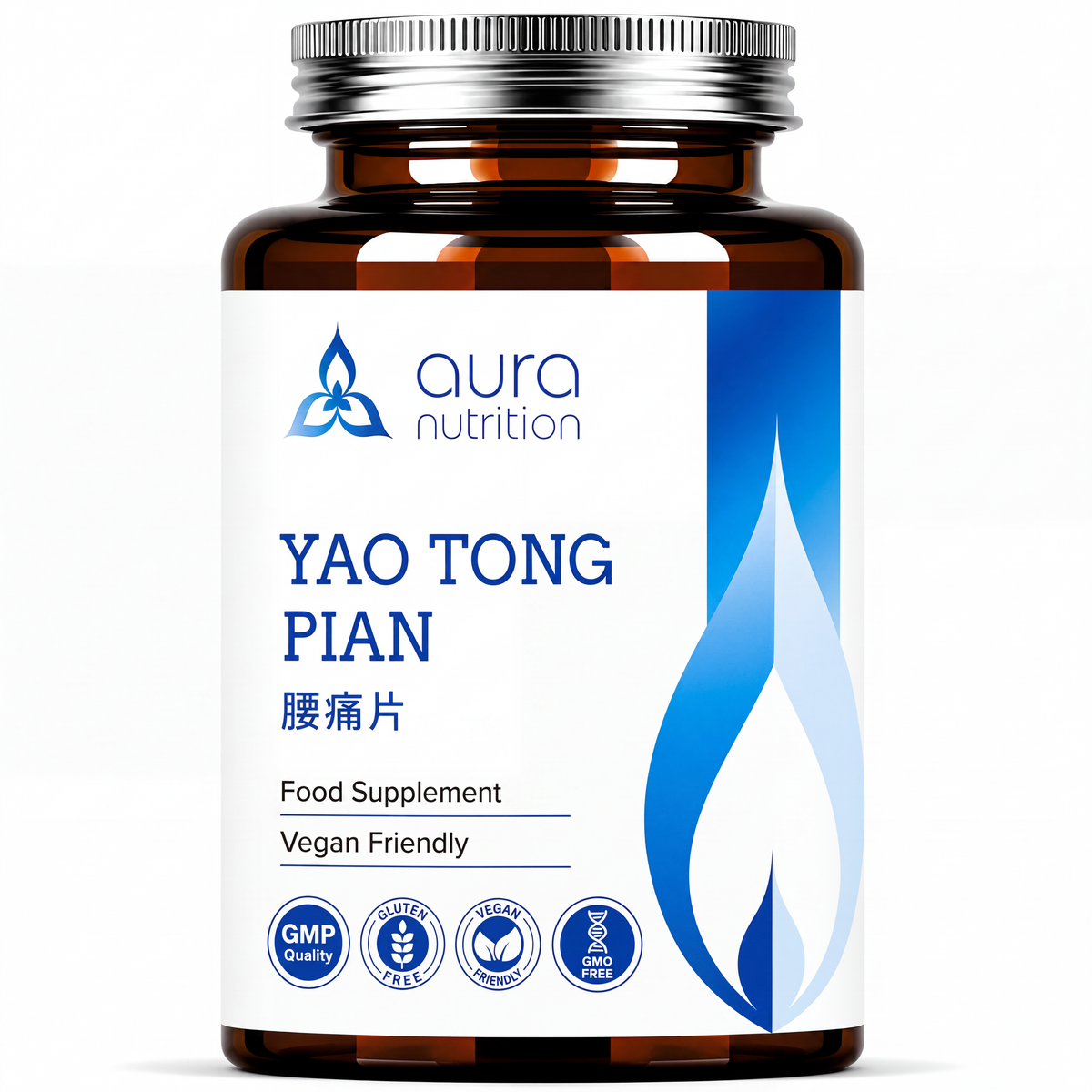
Chinese patent herbal formula
腰痛片 · Eucommia & Teasel · also known as
Chinese medicine has a saying: the lower back is the house of the Kidneys. Yao Tong Pian is a modern pharmacy formula built on exactly that idea, for when the Kidneys are said to be running low on warmth and the small of the back feels it.
Ten herbs, led by eucommia bark and teasel root, with dodder seed, dong quai and a little myrrh. Made into 5:1 tablets. Take six a day; a bottle lasts ten days. Explore the formula
Couldn't load pickup availability
Verified Loox reviews
★★★★☆
"Helped very well with high-level muscular and nervous pain in lower back, spine, and hips. My TCM doctor said this would be good enough to travel with as a backup (and if the country you’re travelling to does not favour…"
★★★★★
"A great product - works well to ease muscle pain"
★★★★★
"I started using these alongside acupuncture to help with neuropathic migraine pain after reacting to prescription medication. After 2 months I have seen a great improvement in my overall health and can't recommend them enough."
★★★★★
"I've had a very positive experience with Xiao Yao San. I started taking it during a period when I was experiencing hormonal changes, mood swings and emotional ups and downs. Since taking it, I've noticed that I feel more balanced…"
★★★★★
"Slowly introduced. No obvious immediate effects. After 2 weeks. I realise life is calmer. Anxiety lessened, joy is there. I feel like me. I will continue. I am taking 2 in the morning and 2 in the evening. I will increase to the…"
★★★★★
"I run The Menopause Herbalist - an on-line service supporting women in navigating peri-menopause and menopause symptoms. I recommend Aura Nutrition to all my patients as I have observed over the last few years the significant…"
Yao Tong Pian's a Chinese patent formula, standardised as a ready-made tablet in the 20th century. It's not out of a classical book and there's no famous name on it, so we won't pretend there is.
And the name? About as literal as Chinese pharmacy names get. Yao is the waist or lower back, tong's an ache, pian's a tablet. That was the label it got in China, and it describes the traditional focus, not a claim we're making.
The idea underneath is properly old, though. The Huang Di Nei Jing, the foundation text of Chinese medicine, calls the lower back 'the house of the Kidneys', and eucommia and teasel have been paired up for that spot for centuries. This formula simply builds on that old double act.
In Chinese medicine
You'd think Kidneys would just be about water, but not in Chinese medicine. They're the root of your warmth (Kidney Yang) and your deep reserves, and they're meant to look after the bones and the lower back too. So when they flag with age or overwork, the small of the back's often where people say they notice it.
In the textbooks it's Kidney Yang deficiency, which looks like a lower back that feels weak and cold, knees that aren't keen, and a real fondness for the hot water bottle. Herbalists also reckoned long-standing weakness lets Blood go sluggish round there, so there's a building side and a moving side to the formula.
Eucommia and teasel lead, as the classic pair for strengthening the Kidneys and lower back. Dodder seed and cinnamon bark bring the warmth, dong quai feeds the Blood, and myrrh with tree peony bark keeps it flowing. White atractylodes and water plantain mop up Damp, and cyathula? That one takes the whole lot downwards.
The Five Elements
Herbalists file the Kidneys under Water, the element of winter, and in this way of thinking Water rules the bones and the lower back. It's on cold, damp days that it's supposed to feel most exposed.
Winter
According to the old texts, this is when cold likes to settle into the lower back.
Kidneys
They're said to govern the bones, and the lower back is their 'house', as the saying goes.
Black
Water's colour. Eucommia bark is a dark greyish brown, which we'll call close enough.
Salty
Eucommia's often stir-fried in salt water before it's used, to point it towards the Kidneys.
Fear
Fear's said to weaken the Kidneys. Dreading bending down to the bottom shelf probably counts, doesn't it?
Traditional use
This is how Chinese herbalists have used this kind of formula. We're describing tradition here, so please don't take it as a medical claim.
The core pattern's a lower back that feels weak and cold, with tired knees to match.
Traditionally a pick for when the weather turns and the small of the back's the first to know about it.
Kidney reserves are said to dip as we get older, which makes it a common choice in later life.
It's popular with people whose jobs or hobbies have them standing, lifting or bending all day.
This section describes traditional use in Chinese herbal practice. Yao Tong Pian is a food supplement and is not intended to diagnose, treat, cure or prevent any disease.
Inside the formula · Ingredients
Arranged like a Chinese royal court, with a chief pair at the top and an envoy pointing the way. Amounts are per daily serving of 6 tablets.
Chief
Eucommia and teasel are the traditional pair for Kidneys and lower back. Snap a bit of eucommia bark and you'll see fine, silvery rubbery threads stretching between the pieces, which is oddly satisfying. Herb Glossary
Ministers
Dodder seed and cinnamon bark are there to warm Kidney Yang, and dong quai nourishes Blood. Herb Glossary
Assistants
Myrrh and tree peony bark keep the Blood moving, while white atractylodes and water plantain clear Damp. Herb Glossary
Envoy
Cyathula's the herb herbalists use when they want to lead a formula down to the lower back and legs. Herb Glossary
Inactive ingredients: Cassava starch, Hypromellose, Magnesium stearate, Polyethylene glycol, Talc.
These are used in very small amounts to form and coat the tablets. They don't add to the formula itself.
How to take
Tablets with water.
Tablets with water.
Most people take a formula for several weeks.
Always follow the label. If you take any medication, are pregnant or breastfeeding, please speak to your GP or pharmacist before use.
Choosing between them
| Compare | Yao Tong Pian | Du Huo Ji Sheng Tang |
|---|---|---|
| First recorded | 20th-century Chinese patent formula | Tang dynasty, around 650 |
| The idea | Warm the Kidneys and keep Blood moving | Clear Wind and Damp, and nourish Kidneys and Liver |
| Herbs | 10, led by eucommia and teasel | 14, led by pubescent angelica |
| Character | Warming, focused on the Kidneys | Warming, broader and building |
| Often chosen when | The lower back feels weak and cold | Stiffness spreads to the knees and limbs |
Yao's the lower back, tong is an ache and pian's a tablet, so it's a very literal Chinese pharmacy name. That's the traditional name, though, and ours is a food supplement that isn't meant for any medical condition.
Chinese medicine calls the lower back the 'house of the Kidneys', so that's where herbalists look first. It's a different way of thinking from Western anatomy, and it's not saying anything about your actual kidneys.
Three in the morning and three in the evening, which is six a day, and a bottle lasts ten days.
No, please give it a miss if you're pregnant, trying to conceive or breastfeeding. Myrrh, cyathula and tree peony bark all move Blood, and herbalists keep well clear of that in pregnancy.
Dong quai and myrrh aren't ones to mix with blood thinners like warfarin. Take any regular medicine? Check with your GP or pharmacist before you start. And if your back's changed suddenly, see your GP first, before you reach for any supplement at all.
They're both warming. Yao Tong Pian keeps its eye firmly on the Kidneys and the small of the back, whereas Du Huo Ji Sheng Tang casts a wider net and clears Wind and Damp from the joints as well.
Related formulas
Verified Loox reviews
Food supplements should not be used as a substitute for a varied, balanced diet and a healthy lifestyle. Not intended to diagnose, treat, cure or prevent any disease. Keep out of reach of children.


