

Dry, itchy-feeling skin
The classic picture it was built around: skin that feels dry and rough and itches, put down to Blood dryness and Wind.


Modern Chinese patent formula
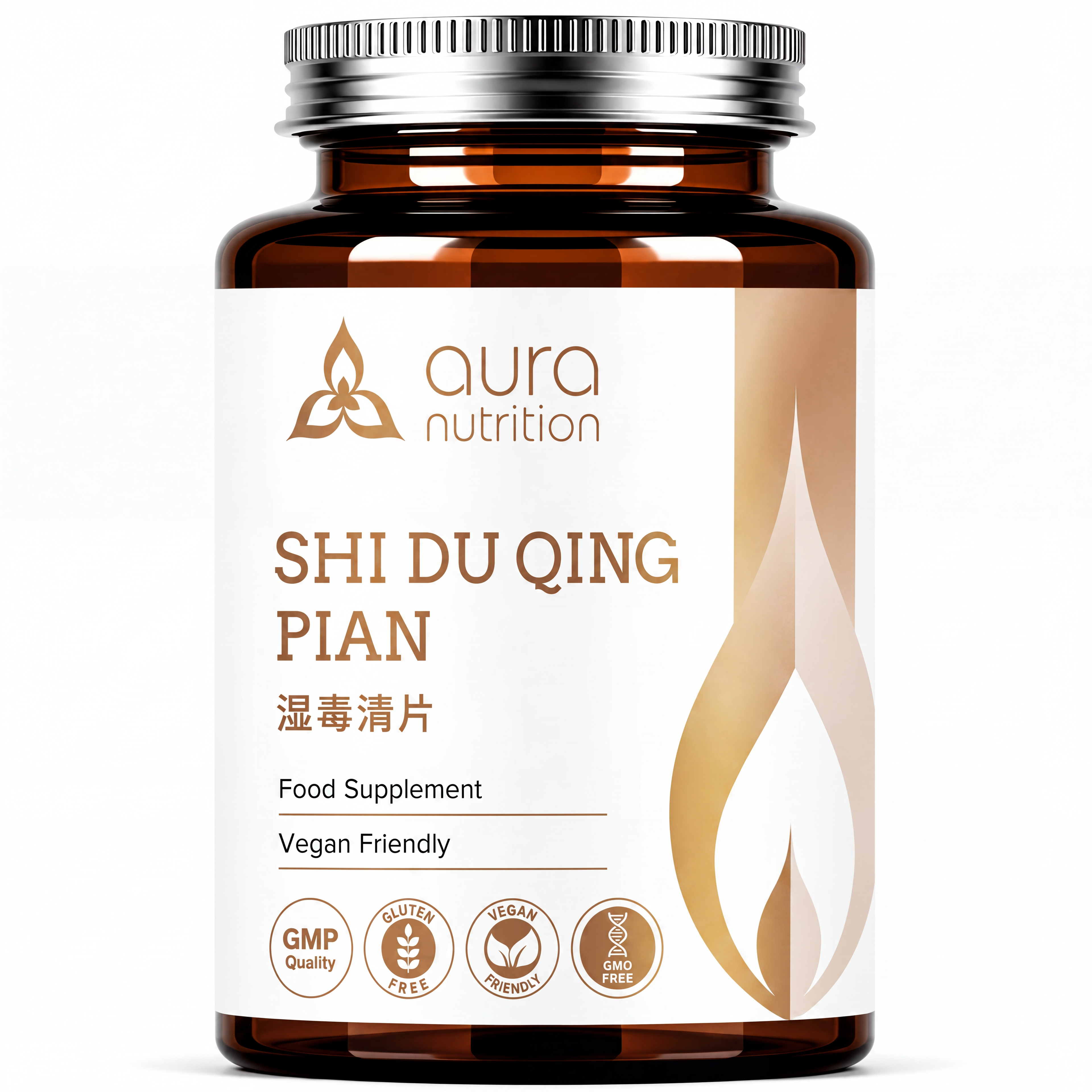
湿毒清片 · Dong Quai & Green Chiretta · also known as
Shi Du Qing Pian is a modern Chinese formula with a very skin-focused story. The name means, roughly, 'clear damp toxin tablet', and herbalists in China use it when skin feels dry, hot and itchy, which the old system puts down to Blood that's run dry and heat that's got stuck.
Eight herbs, led by rehmannia and dong quai, with andrographis (green chiretta) and smilax to cool and clear. Made into 5:1 tablets. Six a day, and a bottle lasts ten days. Explore the formula
Couldn't load pickup availability
Verified Loox reviews
★★★★★
"Before taking the product my arms are red and itchy but now after taking 3 bottles the itchiness was relieved and my skin started to clear up. So, I wanted to buy some more bottles."
★★★★★
"I received excellent service from Aura to reinstate my order after the courier failed to deliver my items. Thank you Aura for helping me receive these effective products. Dawn"
★★★★★
"Reliable supplier! All those herbal supplements are work great in me. I am happy with my purchase. Thank you."
★★★★★
"This gets rid of the wet. Any fungus issues this is your go to. Would highly recommend"
We'll be upfront: this isn't one of the ancient classics. Shi Du Qing Pian is a 20th-century Chinese patent formula, developed so people could take a dermatology-style herbal prescription as simple tablets. The exact recipe varies between makers in China, and ours is our own label version.
The thinking behind it is old, though. There's a well-known saying in Chinese medicine: 'for Wind, look to the Blood first; once the Blood moves, the Wind dies down by itself'. It turns up in Song dynasty writing and has guided skin formulas for centuries. Itchiness, in this system, is Wind. Nourish and move the Blood, and the Wind is said to settle.
So the formula starts from a Blood-building base (rehmannia, dong quai, Sichuan lovage, much like the classic Si Wu Tang) and adds cooling, clearing herbs on top. Andrographis is the striking one. It's ferociously bitter, and its Chinese name, chuan xin lian, means 'thread through the heart lotus'.
In Chinese medicine
In Chinese medicine, Blood doesn't just carry nourishment. It also moistens the skin. When Blood runs low, the theory goes, the skin goes dry and Wind can stir, and Wind shows up as itching that moves about and won't leave you alone.
On top of that, heat and damp can get trapped in the skin. Damp makes things weepy and stubborn, heat makes them red and hot. 'Toxin' in the name doesn't mean poison in the Western sense. It's the old word for heat and damp that have dug in deep.
Rehmannia and dong quai nourish the Blood and moisten. Sichuan lovage and red sage get it moving. Andrographis and scutellaria clear heat, smilax drains damp and liquorice brings it all together. Moisten, move, cool, clear.
The Five Elements
Chinese medicine puts the skin under the Lung, and the Lung under Metal, the element of autumn. Metal is about boundaries, the line between you and the outside world. Your skin is the most obvious one.
Autumn
Metal's season. Dry air, falling leaves, and the time of year dry skin is said to flare.
Lung
Governs the skin and body hair in Chinese medicine, which is why a skin formula ends up here.
White
Metal's colour, pale and clean.
Pungent
Dong quai and Sichuan lovage are both pungent, the taste that spreads things outwards to the surface.
Grief
Metal's emotion. Herbalists have long noticed that skin and low mood can go hand in hand.
Traditional use
This is how Shi Du Qing Pian is used in China, traditionally speaking. It's background, not a medical claim of any kind.
The classic picture it was built around: skin that feels dry and rough and itches, put down to Blood dryness and Wind.
The textbook pattern, where low Blood leaves the skin underfed and restless.
Herbalists chose it when the skin also felt hot and a bit weepy, the 'damp toxin' of the name.
Some people lean on it in autumn and winter, when the air and the heating dry everything out.
This section describes traditional use in Chinese herbal practice. Shi Du Qing Pian is a food supplement and is not intended to diagnose, treat, cure or prevent any disease.
Inside the formula · Ingredients
A modern formula, but it still lines up in the classic court. Amounts are per daily serving of 6 tablets.
Chiefs
Rehmannia and dong quai nourish the Blood and moisten, the foundation everything else rests on. Herb Glossary
Ministers
Andrographis clears heat. Sichuan lovage gets the Blood moving so the Wind can settle. Herb Glossary
Assistants
Red sage moves and cools the Blood. Scutellaria's there to clear heat, and smilax, the knobbly root of a climbing vine, drains damp. Herb Glossary
Envoy
Liquorice softens all that bitterness (and there's a lot of it) and harmonises the formula. Herb Glossary
Inactive ingredients: Cassava starch, Hypromellose, Magnesium stearate, Polyethylene glycol, Talc.
These are used in very small amounts to form and coat the tablets. They don't add to the formula itself.
How to take
Tablets with water.
Tablets with water.
Most people take a formula for several weeks.
Always follow the label. If you take any medication, are pregnant or breastfeeding, please speak to your GP or pharmacist before use.
Choosing between them
| Compare | Shi Du Qing Pian | Fang Feng Tong Sheng San |
|---|---|---|
| First recorded | 20th century, as a Chinese patent formula | Jin dynasty, 1100s |
| The idea | Nourish the Blood, cool and clear the skin | Release the surface and clear heat inside and out |
| Herbs | 8, including andrographis and smilax | 13, including siler, rhubarb and gardenia |
| Character | Nourishing and cooling | Strongly clearing, a bit purging |
| Often chosen when | Skin feels dry, with Blood running low | Someone feels full and hot, with heat trapped inside |
The name more or less translates as 'clear damp toxin', with shi for damp, du for toxin and qing for clearing it out. Don't read too much into 'toxin', mind. Old herbalists just meant heat and damp that had dug in and wouldn't shift. Nothing to do with poison, the way we'd use the word now.
Nope. We'd love to tell you it was found on a bamboo scroll, but it's a 20th-century Chinese patent formula. The herbs are old, mind, and so's the thinking. Just not the recipe.
We'd go with three at breakfast and three in the evening, six all told. You'll get ten days out of a bottle of 60.
Pregnant, trying to conceive or breastfeeding? Then it's not one for you, sorry. Herbalists have always kept andrographis away from pregnancy (it's fiercely bitter stuff, and a few people just don't get on with it at all). With dong quai and red sage in the mix, clotting can be affected, so if you're on warfarin or another blood thinner, please don't put the two together. Oh, and liquorice can nudge your blood pressure up. On any medication at all? Check with your GP first.
No, these are tablets to swallow. Please don't crush them into a cream.
Skin formulas are usually taken for a good few weeks in Chinese practice, as the idea is to rebuild the Blood gradually. If things change or you're unsure, see your GP.
Related formulas
Verified Loox reviews
Food supplements should not be used as a substitute for a varied, balanced diet and a healthy lifestyle. Not intended to diagnose, treat, cure or prevent any disease. Keep out of reach of children.


