

Wound-up days
The classic pick for that tense, stuck, sighing feeling, especially when it's running a bit hot.


Traditional Chinese herbal formula
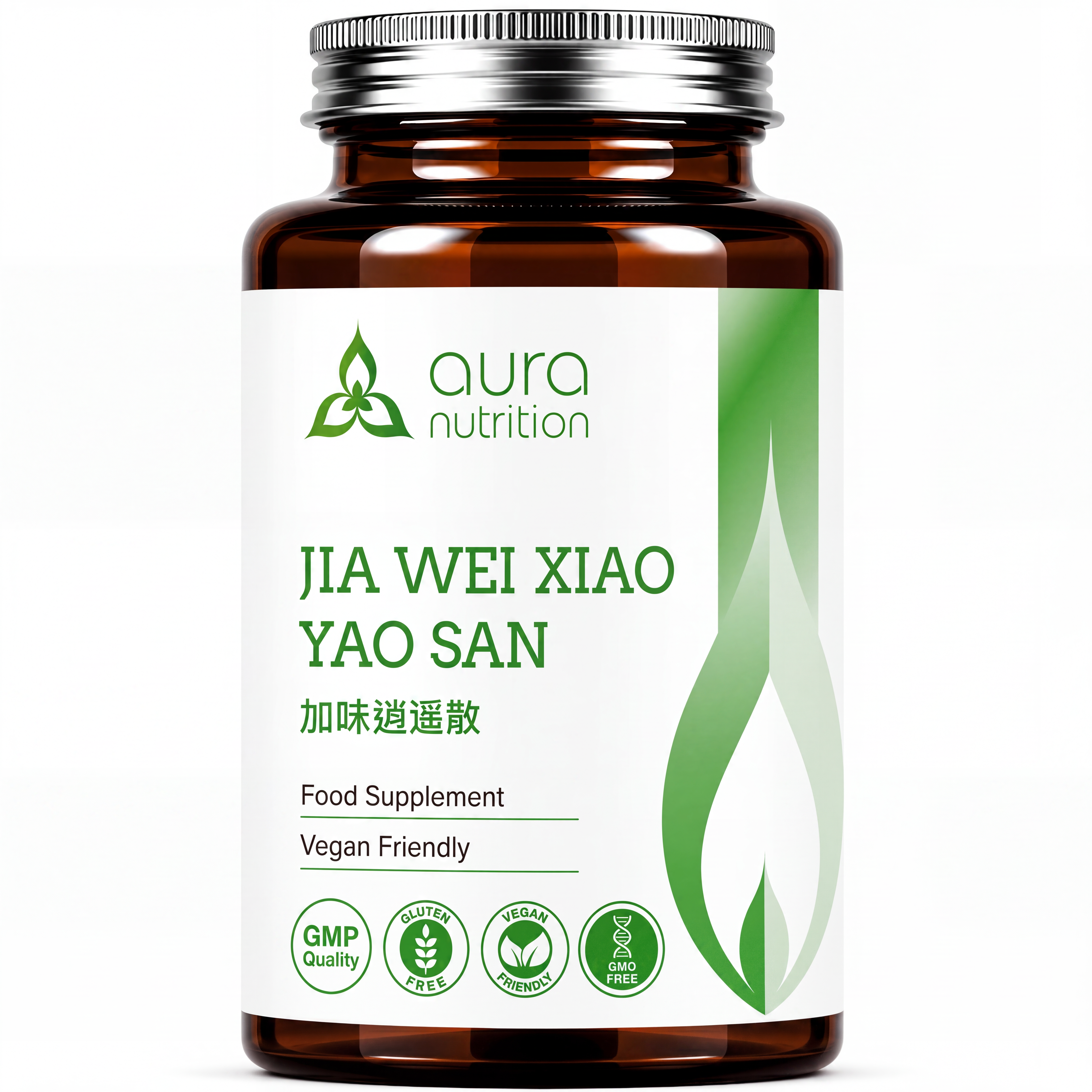
加味逍遥散 · Free and Easy Wanderer Plus · also known as Dan Zhi Xiao Yao San
Our best-seller, by a mile. Jia Wei Xiao Yao San is the famous Free and Easy Wanderer with two cooling herbs added, gardenia and tree peony bark, so herbalists reached for it when tension came with a bit of heat attached. Think short fuse, warm face, restless evenings.
Eight herbs, led by bupleurum, dong quai and white peony, made into 5:1 tablets. Six a day, and a bottle lasts ten days. Explore the formula
Couldn't load pickup availability
Verified Loox reviews
★★★★★
"Have been taking this for a while and it has a calming effect. Happy with aura nutrition :)"
Abbie M. · Video review · Verified buyer★★★★★
"Helped with my fatigue"
Thomas A. · Video review · Verified buyer★★★★★
"The staff are kind, helpful & actually listen & care for their customers wellbeing. The products are great & I experience positive results taking Jia Wei Xiao Yao San & Geng Nian for my moody, sad, depressed, brain fogged,…"
★★★★★
"I started using these alongside acupuncture to help with neuropathic migraine pain after reacting to prescription medication. After 2 months I have seen a great improvement in my overall health and can't recommend them enough."
★★★★★
"I love this herb blend. They have helped me to feel calmer overall and also improved my sleeping, of which I am so, so grateful for. Thank you Aura nutrition!"
★★★★★
"I have been using these for a couple of weeks and have already noticed a big difference in mood, positively. Am ordering another bottle to continue on."
★★★★★
"I've been using this product for a couple of years and wouldn't be without it. My accupucturist recommended it."
★★★★★
"Been taking for one month now . My mood has improved . Ordering my next few months supplies!"
It all begins with Xiao Yao San, written down in the Song dynasty around 1110 in the government's own book of approved recipes. The name's borrowed from Zhuangzi, the old Daoist writer, whose first chapter is about wandering free and easy through life. Lovely thing to name a formula after, isn't it?
Roughly four hundred years on, the Ming physician Xue Ji gave it a tweak. Some of his patients' stuck, tense feeling had started to come with heat, so he added gardenia fruit and tree peony bark and wrote it up in the 1500s. 'Jia wei' only means 'added flavours', and that's honestly the whole story behind the name.
You might also spot it as Dan Zhi Xiao Yao San, named after those two new herbs (Dan from Mu Dan Pi, Zhi from Zhi Zi). Same formula, just a different label on the jar.
In Chinese medicine
The Liver, in Chinese medicine, has really just one job that matters here, and that's keeping Qi flowing smoothly. Pile on enough stress and the theory says the flow snarls up. You'll know the feeling if you've had it: wound up, sighing for England, a bit short with everyone in the days before your period. The old books have a name for it, Liver Qi stagnation.
Stuck Qi is also said to lean on the Spleen (that's digestion and energy, in this system), and if it hangs about long enough it starts making heat. So you end up with tension, tiredness and a flush of irritability all at once. Sound familiar? That's the exact picture Jia Wei Xiao Yao San was built for.
Bupleurum's the one that gets things moving. Dong quai and white peony nourish the Blood so the Liver can relax, and poria and white atractylodes look after the Spleen. Then gardenia and tree peony bark come in to take the edge off the heat, and that's your 'plus'.
The Five Elements
Herbalists put the Liver under Wood, the element of spring. Wood likes to grow freely, a bit like a tree wanting room to spread out, and when it's boxed in it gets tense.
Spring
It's Wood's time of year, when everything wants to push upwards.
Liver
It pairs with the Gallbladder and is said to keep Qi flowing smoothly round the body.
Green
Think new shoots and fresh leaves. Fair enough.
Sour
White peony root brings a little touch of it to this formula.
Anger
Or frustration, really, that feeling of being stuck, which is exactly what this family of formulas is about.
Traditional use
Here's where it turns up most, both in the old texts and in practice today. It's all traditional use, just to be clear, and not medical claims.
The classic pick for that tense, stuck, sighing feeling, especially when it's running a bit hot.
Herbalists have long used it in the days before a period, when moods and tempers get a bit bumpy.
It's popular with women heading into the change, when warmth and irritability tend to turn up together.
Loads of our customers first heard about it from their acupuncturist, because it's a real clinic staple.
This section describes traditional use in Chinese herbal practice. Jia Wei Xiao Yao San is a food supplement and is not intended to diagnose, treat, cure or prevent any disease.
Inside the formula · Ingredients
Chinese formulas are built like a royal court. A chief herb leads, ministers back it up and assistants balance things out. Amounts are per daily serving of 6 tablets.
Chief
Bupleurum's the herb herbalists use to get stuck Liver Qi moving, and everything else is arranged around it. Herb Glossary
Ministers
Dong quai and white peony nourish the Blood, and in this system that's what lets the Liver relax. Herb Glossary
Assistants
Poria and white atractylodes look after the Spleen, while the two 'added' herbs cool things down. Herb Glossary
Envoy
Then honey-fried liquorice, which smooths the whole thing out and helps the herbs pull together. Herb Glossary
Inactive ingredients: Cassava starch, Hypromellose, Magnesium stearate, Polyethylene glycol, Talc.
These are used in very small amounts to form and coat the tablets. They don't add to the formula itself.
How to take
Tablets with water.
Tablets with water.
Most people take a formula for several weeks.
Always follow the label. If you take any medication, are pregnant or breastfeeding, please speak to your GP or pharmacist before use.
Choosing between them
| Compare | Jia Wei Xiao Yao San | Xiao Yao San |
|---|---|---|
| First recorded | Ming dynasty, 1500s | Song dynasty, around 1110 |
| The idea | Free up stuck Qi and cool things down | Free up stuck Qi and look after the Spleen |
| Herbs | 8, including gardenia and tree peony bark | 8, including fresh ginger and mint |
| Character | A little cooler | Gentle and balanced |
| Often chosen when | Tension comes with warmth or a short temper | Tension comes with tiredness and a sluggish tummy |
Jia Wei Xiao Yao San is the original plus two cooling herbs, gardenia and tree peony bark, and herbalists pick it when the tense, stuck feeling comes with heat. Plain Xiao Yao San keeps ginger and mint in their place, and it's a touch gentler.
It's a nod to Zhuangzi, the old Daoist writer, whose first chapter is all about wandering through life free and easy. The formula's named after that feeling of things finally flowing again.
Six a day. We'd go three in the morning and three in the evening, and that way a bottle sees you through ten days.
That's up to you, really. Plenty of our customers just keep going all month, though herbalists tend to pay most attention to the week before. If you're pregnant, trying for a baby or breastfeeding, have a chat with your GP before you start.
Dong quai isn't one to mix with blood thinners like warfarin, so if you take anything regularly, do check with your GP or pharmacist before you start.
Honestly? It's been one of the most used formulas in Chinese clinics for centuries, and acupuncturists recommend it all the time. Plenty of our customers have been taking it for years.
Related formulas
Verified Loox reviews
Food supplements should not be used as a substitute for a varied, balanced diet and a healthy lifestyle. Not intended to diagnose, treat, cure or prevent any disease. Keep out of reach of children.


