


Liver and Kidney deficiency
The core pattern, where Essence and Blood are both thought to be running a bit low.


Traditional Chinese herbal formula
七宝美髯丹 · Seven Treasures (He Shou Wu) · also known as Seven Treasures for Beautiful Whiskers
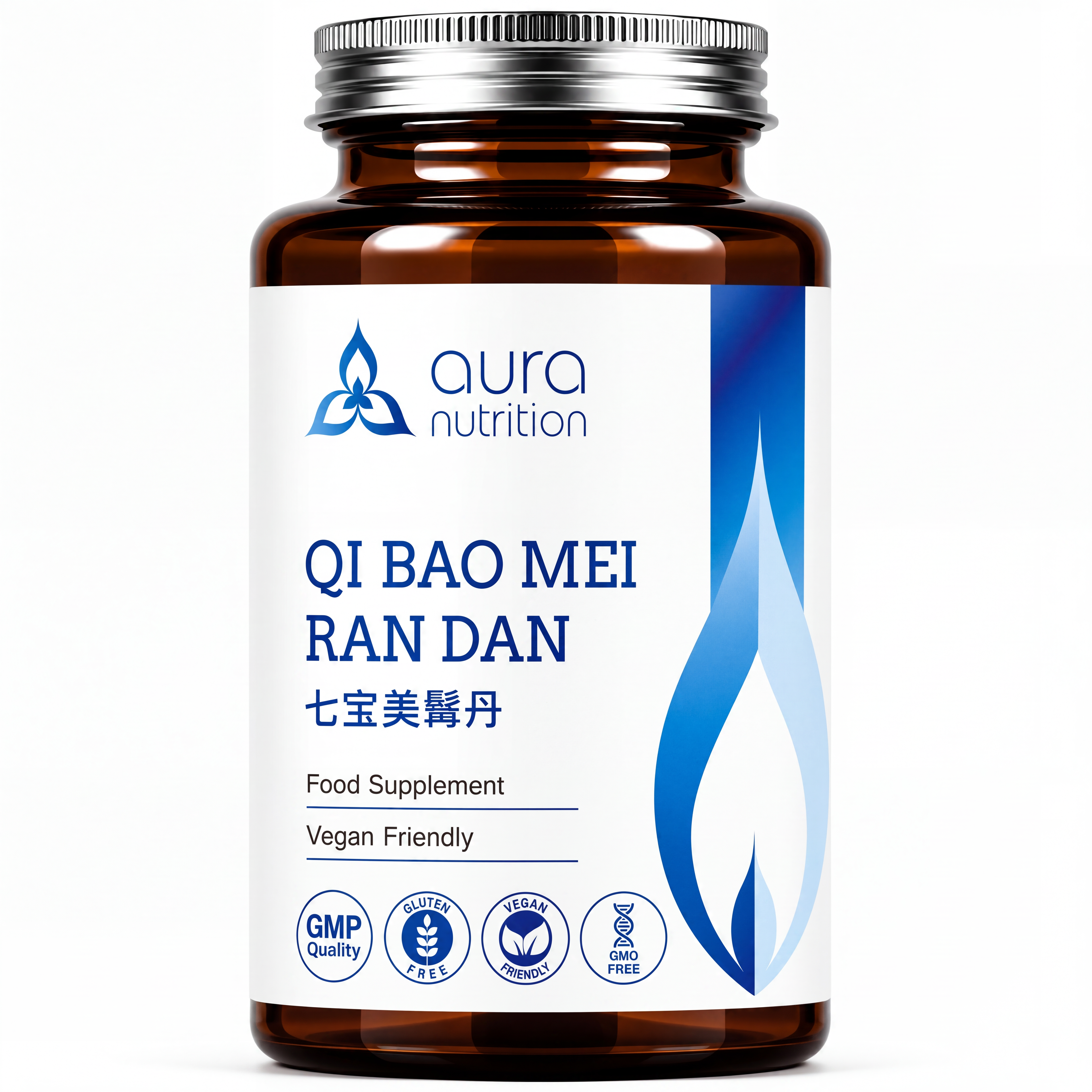
Qi Bao Mei Ran Dan translates as 'seven treasures pill for beautiful whiskers'. Yes, really. It's the most famous formula built on he shou wu (fo-ti), and herbalists used it to nourish the Liver and Kidneys, which in Chinese medicine show up in your hair.
Seven herbs, with fo-ti in the lead and goji berry, dodder seed, dong quai, eucommia, achyranthes and poria in support. Made into 5:1 tablets. Six a day, and a bottle lasts ten days. Explore the formula
Couldn't load pickup availability


Verified Loox reviews
★★★★★
"The staff are kind, helpful & actually listen & care for their customers wellbeing. The products are great & I experience positive results taking Jia Wei Xiao Yao San & Geng Nian for my moody, sad, depressed, brain fogged,…"
★★★★★
"I started using these alongside acupuncture to help with neuropathic migraine pain after reacting to prescription medication. After 2 months I have seen a great improvement in my overall health and can't recommend them enough."
★★★★★
"I've had a very positive experience with Xiao Yao San. I started taking it during a period when I was experiencing hormonal changes, mood swings and emotional ups and downs. Since taking it, I've noticed that I feel more balanced…"
★★★★★
"Slowly introduced. No obvious immediate effects. After 2 weeks. I realise life is calmer. Anxiety lessened, joy is there. I feel like me. I will continue. I am taking 2 in the morning and 2 in the evening. I will increase to the…"
★★★★★
"I run The Menopause Herbalist - an on-line service supporting women in navigating peri-menopause and menopause symptoms. I recommend Aura Nutrition to all my patients as I have observed over the last few years the significant…"
★★★★★
"This supplement has really helped me. I started with night sweats following a partial hysterectomy and they have reduced dramatically! My energy levels are also picking up gradually. I don’t quite take the full dose as yet as I…"
Fo-ti's Chinese name, He Shou Wu, means 'Mr He's black hair', and there's a Tang dynasty tale behind it about an elderly man called He who found the root, ate it, and kept a dark head of hair well into old age. Did he ever exist? Anyone's guess, honestly. The name stuck regardless.
The formula itself turns up in Li Shizhen's great herbal, the Ben Cao Gang Mu, finished in 1578. Li tells how a Daoist called Shao Yingjie presented it to the Jiajing emperor of the Ming dynasty, who was reportedly rather pleased with the results (heirs, mainly), and after that everyone wanted a bit.
Psoralea was one of the seven treasures in the classic recipe. We've swapped that slot for eucommia bark, another warming Kidney herb, and kept the other six as they were. Oh, and 'mei ran'? That means beautiful whiskers. A beard was a big deal for a Ming gentleman, apparently.
In Chinese medicine
There's a lovely idea in Chinese medicine that every organ has a 'flower', somewhere its health shows on the outside. For the Kidneys it's the hair on your head. The Liver, which stores Blood, gets the nails and, again, the hair, which is called the 'surplus of Blood'. So hair's doing double duty.
Which means that as Kidney Essence and Liver Blood run low with age, the old books expected you'd see it: greying early, thinning hair, a weak lower back and knees, a general sense of winding down. They called it Liver and Kidney deficiency. In this system's eyes it's mostly just what getting older looks like.
Fo-ti's the chief, there to nourish Essence and Blood both. Goji berry and dodder seed back up the Kidneys, while dong quai feeds the Blood. Eucommia and achyranthes are in for the lower back and knees, and poria? That's there so all this richness doesn't sit heavy on your digestion.
The Five Elements
The Kidneys sit under Water, winter's element. Water's where your deepest reserves live, the Essence, and its 'flower' is the hair, which is how you end up with a formula about whiskers.
Winter
Water's season, and the season of life when reserves begin to dip.
Kidneys
They're said to store Essence and show how they're doing in the hair, and fo-ti's the classic herb for both.
Black
Water's colour, and the hair colour Mr He hung on to, if you believe the legend.
Salty
That's Water's taste. Fo-ti itself is more bitter and sweet, mind.
Fear
Fear's said to drain the Kidneys, and in this way of thinking a long spell of dread can show up in your hair.
Traditional use
Here's how Chinese herbalists have used Seven Treasures down the centuries. It's traditional use we're describing, so please don't read any of it as a health claim.
The core pattern, where Essence and Blood are both thought to be running a bit low.
Historically, this was the formula people in China linked with keeping a dark head of hair.
It's long been a pick for the later years, to nourish those deep reserves.
Herbalists also chose it when the lower body felt weak along with everything else.
This section describes traditional use in Chinese herbal practice. Qi Bao Mei Ran Dan is a food supplement and is not intended to diagnose, treat, cure or prevent any disease.
Inside the formula · Ingredients
Laid out like a Chinese royal court, with fo-ti very clearly in charge. Amounts are per daily serving of 6 tablets.
Chief
Fo-ti's in here at the biggest amount by a mile, more than double anything else on the label. It's a knobbly, reddish-brown root, and herbalists reach for it to nourish Liver Blood and Kidney Essence. Herb Glossary
Ministers
Then there are goji berries and dodder seed, which are in for the Kidneys, with dong quai looking after the Blood side. Herb Glossary
Assistants
Eucommia (snap the bark and you'll see fine silvery threads, oddly) and achyranthes are the traditional lower back and knees pair, and poria's there to stop all of this sitting heavy on your digestion. Herb Glossary
Inactive ingredients: Cassava starch, Hypromellose, Magnesium stearate, Polyethylene glycol, Talc.
These are used in very small amounts to form and coat the tablets. They don't add to the formula itself.
How to take
Tablets with water.
Tablets with water.
Most people take a formula for several weeks.
Always follow the label. If you take any medication, are pregnant or breastfeeding, please speak to your GP or pharmacist before use.
Choosing between them
| Compare | Qi Bao Mei Ran Dan | Liu Wei Di Huang Wan |
|---|---|---|
| First recorded | Ming dynasty, 1500s | Song dynasty, 1119 |
| The idea | Nourish Liver Blood and Kidney Essence | Nourish Kidney Yin |
| Herbs | 7, led by fo-ti | 6, led by rehmannia |
| Character | Rich, gently warming | Nourishing, slightly cooling |
| Often chosen when | Blood and Essence both feel depleted | There's dryness or warmth with the tiredness |
Mei ran means a fine beard. In Ming China a full, dark beard was a sign of vigour and this formula was famous for it, since Chinese herbalists see hair as the outward sign of how the Kidneys are doing.
Yep, same thing. 'Fo-ti' is just what Western shops call He Shou Wu, the root of Reynoutria multiflora. It's not usually used raw, either. Herbalists prepare it first, and the traditional way is to steam it with black beans.
Do read this one carefully, please. The UK MHRA has warned that he shou wu has been linked with rare liver reactions. So if you've got liver problems now, or you've had them in the past, this isn't one for you, and please don't double up with any other supplement that contains he shou wu. If you spot yellowing of your skin or eyes, dark urine, pale stools or you feel unusually tired, stop taking it and go and see your GP.
Pregnant or breastfeeding? Then it's one to avoid, since dong quai and achyranthes move Blood. Blood thinners like warfarin are another one to watch, because dong quai and goji berry may interact with them. Basically, if there's a regular medicine in your cupboard, run this past your GP or pharmacist first.
Six a day, three in the morning and three in the evening. That works out at ten days per bottle.
The original had psoralea seed in it. We've put eucommia bark in that slot instead, another warming Kidney herb with a long history behind it, and the other six treasures are the classic line-up.
Related formulas
Verified Loox reviews
Food supplements should not be used as a substitute for a varied, balanced diet and a healthy lifestyle. Not intended to diagnose, treat, cure or prevent any disease. Keep out of reach of children.


