

Simply tired
The textbook choice for plain Spleen Qi deficiency: low energy, pale, a soft voice.


Traditional Chinese herbal formula
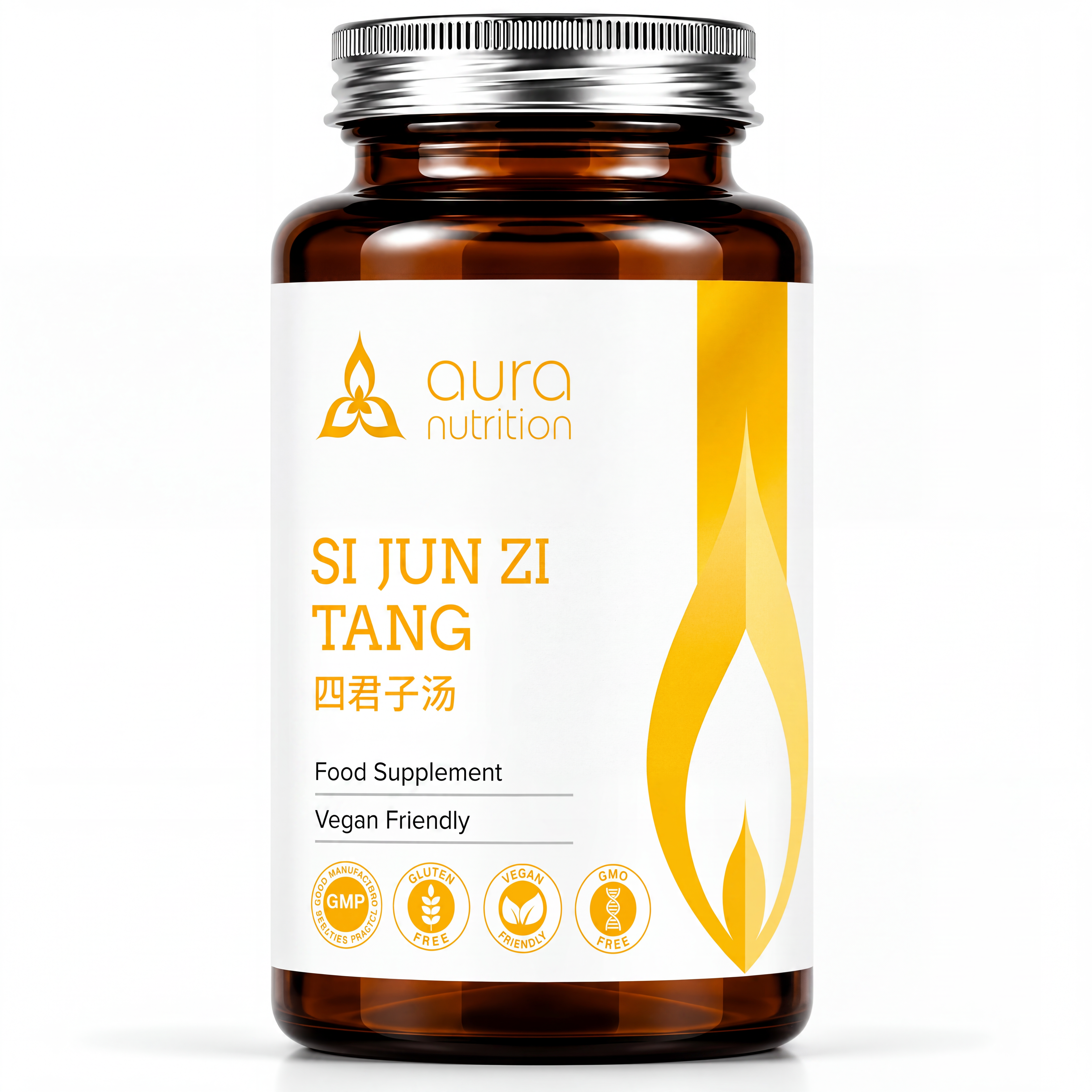
四君子汤 · Four Gentlemen · also known as Si Jun Zi Wan
Four herbs, all mild and well behaved, which is how they earned the name. Si Jun Zi Tang is the most basic Spleen formula in Chinese herbalism, the one herbalists turned to when someone was simply tired, pale and not very hungry. No drama. Just a steady top-up for the middle.
Ginseng, white atractylodes, poria and liquorice, made into 5:1 tablets. Six a day, and a bottle lasts ten days. Explore the formula
Couldn't load pickup availability
Verified Loox reviews
★★★★☆
"Have been taking these for some time for gastro related issues, have seen difference in energy levels and moderate relief from symptoms. I still need to finish one month course, so midway there at the moment but for now, i can…"
★★★★★
"I love this product! It's cleared out my body of candida overgrowth and I'm starting to feel fantastic, in just 2 weeks! Energy levels, focus and overall health are getting better and better with each day. Brilliant stuff!"
★★★★★
"Well packaged and delivered quickly thank you Aura"
★★★★★
"All are fantastic, feel better 😊"
Si Jun Zi Tang was published around 1110 in the Tai Ping Hui Min He Ji Ju Fang, the Song government's official book of recipes. The idea of that book was simple: pharmacies across the empire should make the same formulas the same way. This was one of them.
The name is a compliment. A junzi, in Confucian thinking, is a gentleman of good character, moderate and even-tempered and never extreme. The four herbs here are like that: mild, neither hot nor cold, nothing harsh. Rather a nice way to describe a recipe.
It's thought to have grown out of an older Shang Han Lun formula, Li Zhong Wan, with poria swapped in for dried ginger to make it gentler. And it's had plenty of children since. Add two herbs and you get the Six Gentlemen. Add four Blood herbs and it's Ba Zhen Tang, the Eight Treasures.
In Chinese medicine
Chinese medicine credits the Spleen and Stomach with turning your food into Qi, and that's meant to be where nearly all your everyday energy comes from. So if the Spleen's weak, the theory goes, the whole system runs a little low, a bit like a phone stuck on twenty per cent.
Herbalists call that Spleen Qi deficiency. Nothing dramatic about it, honestly. We picture the friend who's always a bit pale and quietly spoken, who picks at their dinner, whose legs feel heavy on the stairs and who'll grab the nearest chair whenever there's one going. Maybe a loose tummy now and again too. Not hot, not cold, just running on fumes.
Ginseng's there to build Qi. White atractylodes strengthens the Spleen and dries out Damp, then poria drains Damp and steadies things, and liquorice warms and smooths the lot over. Four herbs, four jobs, nobody stepping on anyone's toes. A tidy little team, really.
The Five Elements
The Spleen and Stomach sit under Earth, the steady centre of the Five Elements. Earth feeds everything else. Get the centre right, Chinese medicine says, and the rest has something to build on.
Late summer
Earth's season, ripe and heavy. Humid days are said to weigh on the Spleen.
Spleen
Paired with the Stomach, and said to make Qi from food. All four herbs here are for it.
Yellow
Earth's colour. White atractylodes is a pale golden yellow once sliced.
Sweet
Ginseng and liquorice give a mild sweetness, the taste said to feed the Spleen.
Worry
Earth's emotion. Overthinking is said to tire the Spleen, so a calm mind helps it too.
Traditional use
Here's how it's been used in Chinese herbal tradition. Please read it as history, not as a claim about health.
The textbook choice for plain Spleen Qi deficiency: low energy, pale, a soft voice.
Used when appetite was small and food didn't seem to give much back.
Because it's so mild, herbalists were happy giving it to grandparents and to folk whose stomachs are easily upset.
Practitioners use it as a base and tack extra herbs on for whoever's in front of them, and that's basically where all its spin-offs came from.
This section describes traditional use in Chinese herbal practice. Si Jun Zi Tang is a food supplement and is not intended to diagnose, treat, cure or prevent any disease.
Inside the formula · Ingredients
Chinese formulas are built like a royal court. Here it's a small and very polite one. Amounts are per daily serving of 6 tablets.
Chief
Ginseng's in charge here. In Chinese medicine it's the Qi herb, the one you'd name first, and it's there to build up the Spleen and your energy in general. Hold a good root up and you'll often see two little legs (that's where "ren", person, in Ren Shen comes from). Herb Glossary
Minister
White atractylodes looks a bit like a lumpy pale knuckle of ginger. Herbalists say it firms up the Spleen and dries out Damp. Herb Glossary
Assistant
Poria's odd stuff, a fungus dug up from round the roots of pine trees, chalky white when you cut it. It's used to drain Damp and settle the mind so that all that tonifying doesn't sit like a stodgy pudding. Herb Glossary
Envoy
And liquorice, faintly sweet, looks after the middle while keeping the other three on speaking terms. Herb Glossary
Inactive ingredients: Cassava starch, Hypromellose, Magnesium stearate, Polyethylene glycol, Talc.
These are used in very small amounts to form and coat the tablets. They don't add to the formula itself.
How to take
Tablets with water.
Tablets with water.
Most people take a formula for several weeks.
Always follow the label. If you take any medication, are pregnant or breastfeeding, please speak to your GP or pharmacist before use.
Choosing between them
| Compare | Si Jun Zi Tang | Li Zhong Wan |
|---|---|---|
| First recorded | Song dynasty, around 1110 | Han dynasty, around 200 AD |
| The idea | Build up Spleen Qi, gently | Warm the middle and build up the Spleen |
| Herbs | 4, including poria | 4, including ginger |
| Character | Mild and neutral | Warming |
| Often chosen when | Tiredness and a small appetite, without much cold | Tiredness comes with chilliness and a cold tummy |
A herbalist would say Spleen Qi deficiency. We'd say you're worn out, looking a bit peaky and you can't face a big plate of anything. Just bear in mind it's a food supplement, so it's not meant for any medical condition.
Ha, it's meant kindly! Confucius went on and on about the junzi, the decent, level-headed sort who never makes a scene. All four herbs here are mild like that, so they got the nickname and it's never worn off.
Six a day, so 3 with breakfast and 3 at teatime is what most people do. With 60 in a bottle that's ten days.
Gentle as it is, we'd still want you to ask your GP first if you're pregnant or breastfeeding, or you're on any regular medication. Two things to flag. Ginseng and blood thinners such as warfarin shouldn't be mixed without advice. And liquorice can nudge blood pressure up, so mention it if yours runs high or you take heart medicines.
The way herbalists split it, the Four is for plain tiredness with a small appetite. Once you add a full, bloated or slightly queasy feeling into the mix, they'd usually go up to the Six instead, or to Xiang Sha Liu Jun Zi Tang (that one's got extra fragrant herbs in to get things moving).
Practitioners combine it with other things constantly. It's the basic building brick of Spleen formulas, after all! Doing it yourself is different, though, so please have a chat with a qualified herbalist before you start doubling up.
Related formulas
Verified Loox reviews
Food supplements should not be used as a substitute for a varied, balanced diet and a healthy lifestyle. Not intended to diagnose, treat, cure or prevent any disease. Keep out of reach of children.


