

Dry Intestines
The core pattern's Blood deficiency leaving the Large Intestine dry and slow.


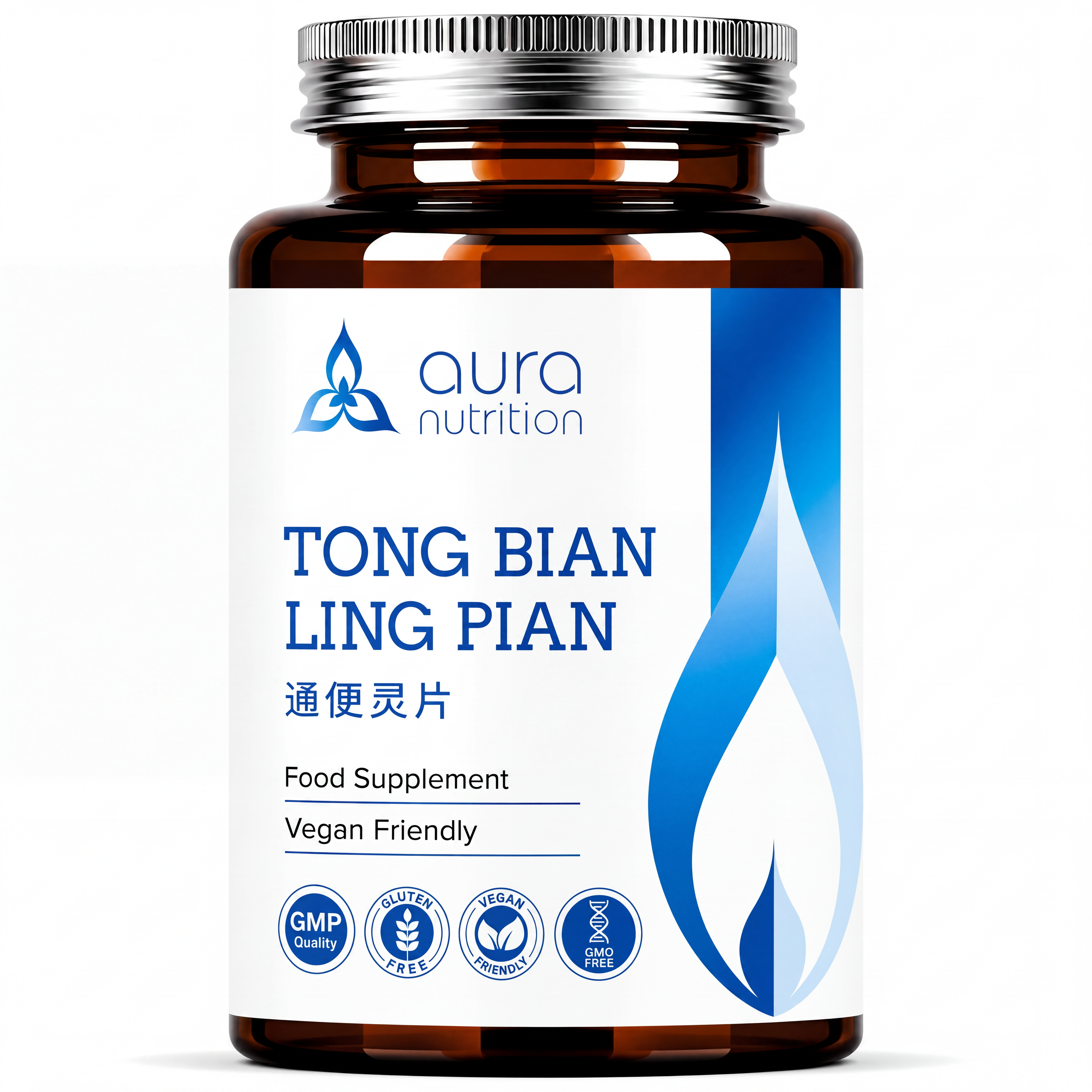
Chinese patent herbal formula
通便灵片 · Peach Kernel & Rhubarb · also known as
Short, simple and to the point. Tong Bian Ling Pian has just four herbs, and most of it is peach kernel, an oily seed herbalists have long used to moisten. The old idea is that when Blood runs thin, the Large Intestine dries out and things slow right down.
Peach kernel leads, with dong quai, rhubarb root and siler. Made into 5:1 tablets. Six a day, three morning and evening, and a bottle lasts ten days. Explore the formula
Couldn't load pickup availability
Verified Loox reviews
★★★★★
"I love that aura nutrition comes in brown glass bottles always fast delivery. Like having a Chinese Dr in your pocket. Thank you"
★★★★★
"Sorts out constipation like nothing else!"
★★★★★
"Fantastic,very happy"
Tong Bian Ling Pian's a Chinese patent formula, standardised as a tablet in the 20th century, so there's no ancient author to credit for this exact recipe. The family resemblance, though? Hard to miss.
Back in 1249, Li Dongyuan, one of the great physicians of the Jin and Yuan era, wrote the Pi Wei Lun (Treatise on the Spleen and Stomach), and tucked inside it is Run Chang Wan, the 'moisten the intestines pill'. That one used peach kernel, dong quai, rhubarb, a wind herb and hemp seed. Swap the wind herb for siler, lose the hemp seed, and you're very nearly looking at this formula.
Now, the name. Tong means to open or unblock, bian's the bowels and ling means effective. Chinese pharmacy names are rarely subtle, are they? UK food law, happily or not, means we've got to be a lot more careful with our own wording.
In Chinese medicine
Chinese medicine pairs the Large Intestine with the Lung, and its job's pretty simple: letting go of what the body's done with. The old texts say it needs to stay moist to manage that, and it's Blood and fluids that keep it that way.
When Blood runs thin (age, a long illness, or just a depleting few years will do it), herbalists believed the Intestines dried out, leaving a slow, dry, stuck sort of feeling. In the books it's Blood deficiency with Intestinal dryness, and Li Dongyuan went on about it at some length.
Peach kernel's packed with oil, so it moistens, and it keeps Blood moving too. Dong quai nourishes the Blood that's in short supply. Rhubarb root is the one that gets things heading downwards. Siler, a 'wind' herb, looks like the odd one out, but Li Dongyuan liked a bit of lift in his downward formulas. It's about balance, basically.
The Five Elements
Under the Five Elements the Large Intestine sits with the Lung in Metal, autumn's element. Metal's all about refining and letting go of what's finished with, which suits this one down to the ground.
Autumn
In Chinese medicine it's the dry season, and dryness is exactly what this formula's about.
Large Intestine
It pairs with the Lung. Its job is letting go, and it's said to need moisture to do it properly.
White
Metal's colour. Crack open a peach stone and the kernel inside is creamy white, a bit like an almond.
Pungent
That's Metal's taste, and siler and dong quai both carry a little spice.
Grief
Metal's emotion, and the emotion of letting go. Not easy, in either sense, is it?
Traditional use
This is how Chinese herbalists have traditionally used formulas of this sort. It's tradition only, so please don't take it as a medical claim.
The core pattern's Blood deficiency leaving the Large Intestine dry and slow.
Fluids and Blood are said to dwindle as we age, so herbalists often had older folk in mind.
A traditional choice when someone's Blood had gone thin after a long, draining stretch.
It's traditionally taken for a short spell, not kept in the routine for months on end.
This section describes traditional use in Chinese herbal practice. Tong Bian Ling Pian is a food supplement and is not intended to diagnose, treat, cure or prevent any disease.
Inside the formula · Ingredients
A small formula, but it still follows the Chinese court structure: a chief, two ministers and one assistant. Amounts are per daily serving of 6 tablets.
Chief
Peach kernel's the biggest amount by a long way, and its oils are what herbalists rely on to moisten the Intestines. Herb Glossary
Ministers
Dong quai nourishes Blood and is a touch oily itself. Rhubarb root, meanwhile, is the classic herb for moving things downwards. Herb Glossary
Assistant
Siler adds a gentle lift (a Li Dongyuan trademark), so the formula isn't all pointing one way. Herb Glossary
Inactive ingredients: Cassava starch, Hypromellose, Magnesium stearate, Polyethylene glycol, Talc.
These are used in very small amounts to form and coat the tablets. They don't add to the formula itself.
How to take
Tablets with water.
Tablets with water.
Most people take a formula for several weeks.
Always follow the label. If you take any medication, are pregnant or breastfeeding, please speak to your GP or pharmacist before use.
Choosing between them
| Compare | Tong Bian Ling Pian | Yi Zi Tang |
|---|---|---|
| First recorded | 20th-century patent, after a 1249 classic | Japan, Edo period, around 1800 |
| The idea | Moisten the Intestines and nourish Blood | Clear Heat and lift what's sinking |
| Herbs | 4, led by peach kernel | 5, led by bupleurum |
| Character | Moistening | Cooling and lifting |
| Often chosen when | Things feel dry and slow | There's Heat and a heavy, dragging feeling low down |
Tong is to unblock, bian is the bowels and ling means effective. That's the traditional Chinese pharmacy name, mind, and ours is a food supplement that isn't meant for any medical condition.
Li Dongyuan, whose 13th-century formula this one resembles, liked adding a small 'wind' herb to lift a formula so it didn't just push downwards, and siler does that job here.
You'd take three in the morning and three in the evening, and a bottle lasts ten days.
It's not really one for the long haul. Rhubarb root's a strong herb and herbalists traditionally use formulas like this for short spells. If your bowel habits have changed and stayed changed for a few weeks, please go and see your GP instead of reaching for a supplement.
No, afraid not. Peach kernel moves Blood and rhubarb root's too strong for pregnancy, so please give it a miss then, and while you're breastfeeding too.
On blood thinners like warfarin? Then dong quai and peach kernel aren't for you. Rhubarb can lower potassium, which matters if you take diuretics or heart medicines like digoxin. So do check with your GP or pharmacist first, and please don't go over the stated amount.
Related formulas
Verified Loox reviews
Food supplements should not be used as a substitute for a varied, balanced diet and a healthy lifestyle. Not intended to diagnose, treat, cure or prevent any disease. Keep out of reach of children.


