

Weak Wei Qi
The classic pattern: a flimsy outer screen that lets wind in easily.


Traditional Chinese herbal formula
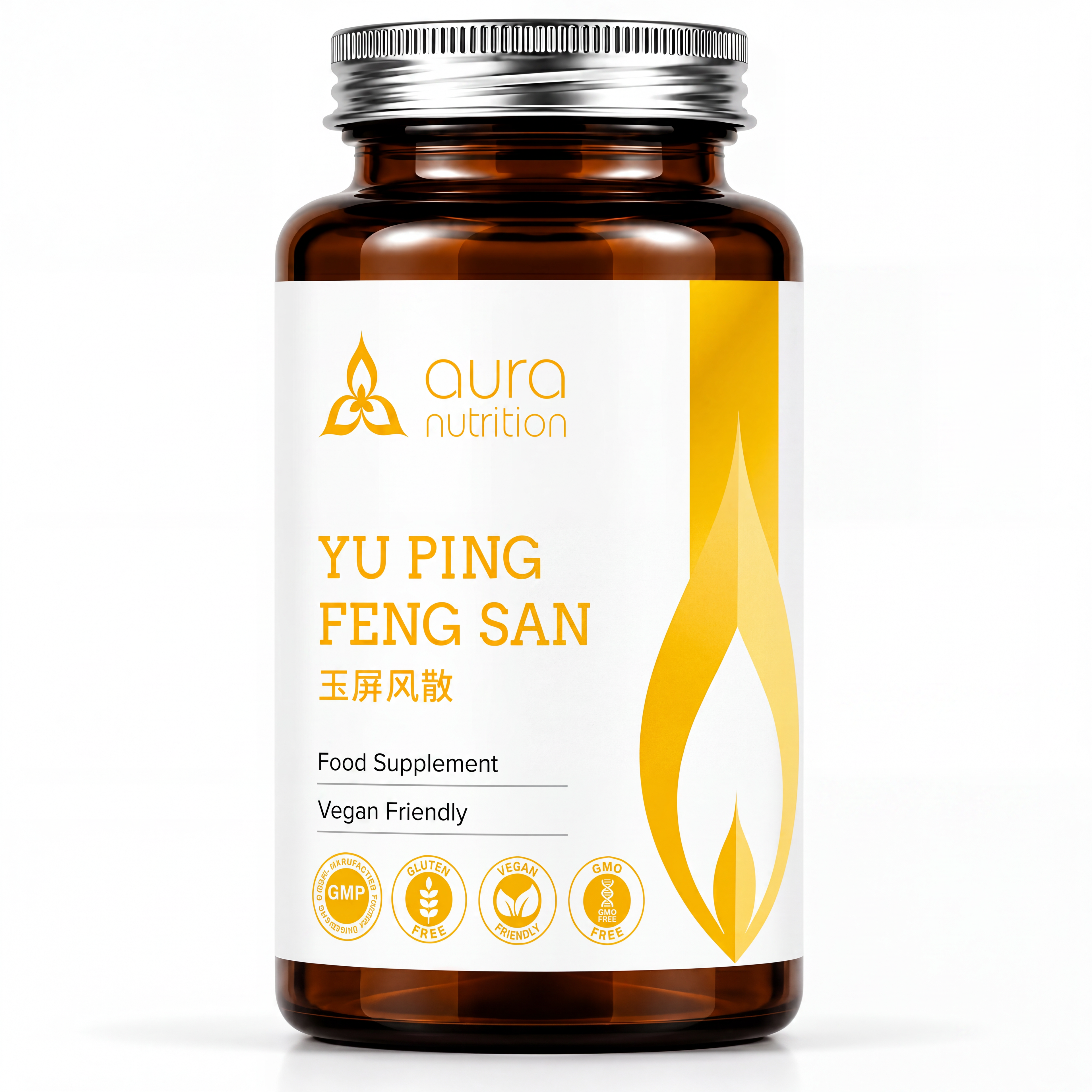
玉屏风散 · Jade Windscreen · also known as Yu Ping Feng Wan
Possibly the prettiest name in Chinese herbalism. Yu Ping Feng San means 'jade windscreen powder', after the decorative screens that stood behind doorways in old Chinese homes to stop draughts. Herbalists used it to shore up the body's own outer screen, which they called Wei Qi.
Just three herbs: white atractylodes, astragalus and siler. Made into 5:1 tablets. Six a day, so a bottle lasts ten days. Explore the formula
Couldn't load pickup availability
Verified Loox reviews
★★★★★
"These are super easy to swallow and have no bitter after taste, I would definitely recommend them."
★★★★★
"Nourished Yin. Dispersed the heat."
★★★★★
"Very good"
Yu Ping Feng San goes back to the Song dynasty. Its earliest known version is usually traced to a book from the early 1200s that only survives in quotations, so we can't be too precise. It became famous later, through the school of Zhu Danxi, one of the great physicians of the Yuan dynasty.
The name is the best bit. Wealthy homes in old China had a ping feng, a standing screen just inside the door. It blocked draughts (and, so people said, wandering spirits, which can only travel in straight lines). Make it from jade and you've got the finest, sturdiest screen money can buy.
With only three herbs, it's one of the simplest formulas in the books. It's still hugely popular in China and has found plenty of fans abroad, partly because it's so easy to explain. Even our delivery driver gets the screen idea.
In Chinese medicine
Chinese medicine describes a kind of Qi that patrols the surface of the body, just under the skin. It's called Wei Qi, usually translated as defensive Qi. Its job is to keep the outside out, opening and closing the pores as needed.
When Wei Qi is weak, the old texts say, the screen gets flimsy. Wind slips in easily and the pores don't close properly, so you sweat at the slightest effort. The textbook term is 'exterior deficiency'. You might just call it being a bit delicate.
Astragalus firms up the surface, and white atractylodes builds Qi from the Spleen, which is where Wei Qi is said to be made. Then you've got siler. Its Chinese name, fang feng, literally means 'guard against wind', and that's its job here. Herbalists love an analogy, so: the first two are the screen, and siler's the bloke on the door.
The Five Elements
In Chinese medicine the Lung looks after the skin and Wei Qi, and it sits under Metal, autumn's element. Metal's about protection, about knowing where your edges are. A windscreen, basically.
Autumn
Metal's season, when the weather turns and the wind picks up. Herbalists often start this formula as the leaves fall.
Lung
In charge of the skin, the pores and Wei Qi, the body's outer defences in Chinese medicine.
White
Metal's colour. Jade screens were often a soft creamy white.
Pungent
Siler is pungent, the taste that reaches the surface of the body.
Grief
Metal's emotion. The old view is that long sadness weakens the Lung, and with it the screen.
Traditional use
Here's how Yu Ping Feng San has been used by herbalists over the centuries. Traditional use only. No medical claims here.
The classic pattern: a flimsy outer screen that lets wind in easily.
You know the one. First to shut the window, first to say 'there's a nip in the air', and they can feel a draught from a door three rooms away. That's who herbalists had in mind.
In China, plenty of folk would start it around autumn, when the wind gets up and you're suddenly eating dinner in the dark.
In the old books, sweating at the slightest effort is a sign of a leaky screen, and a key reason to pick this formula.
This section describes traditional use in Chinese herbal practice. Yu Ping Feng San is a food supplement and is not intended to diagnose, treat, cure or prevent any disease.
Inside the formula · Ingredients
The smallest court we sell. Astragalus leads, even though atractylodes is the larger amount here. Amounts are per daily serving of 6 tablets.
Chief
Astragalus firms up Wei Qi and the surface. It's the frame of the screen. Herb Glossary
Minister
White atractylodes strengthens the Spleen, the source of the Qi that the screen is made of. Herb Glossary
Assistant
Siler, 'guard against wind', keeps wind out without weakening the surface. Herb Glossary
Inactive ingredients: Cassava starch, Hypromellose, Magnesium stearate, Polyethylene glycol, Talc.
These are used in very small amounts to form and coat the tablets. They don't add to the formula itself.
How to take
Tablets with water.
Tablets with water.
Most people take a formula for several weeks.
Always follow the label. If you take any medication, are pregnant or breastfeeding, please speak to your GP or pharmacist before use.
Choosing between them
| Compare | Yu Ping Feng San | Gui Zhi Tang |
|---|---|---|
| First recorded | Song dynasty, early 1200s | Han dynasty, around 200 AD |
| The idea | Build up Wei Qi so wind can't get in | Harmonise the surface once wind has got in |
| Herbs | 3: astragalus, atractylodes and siler | 5, including cinnamon twig and white peony |
| Character | Steady and strengthening | Gently warming |
| Often chosen when | Wei Qi feels weak and the surface leaky | Wind has already got in |
'Yu' is jade, 'ping feng' is a standing screen that blocks the wind. The formula is meant to work like a precious screen around the body's surface, in Chinese-medicine terms.
Traditionally, as the seasons change, especially heading into autumn and winter. Some people keep it going right through the colder months.
Three in the morning, three in the evening, so six a day. You'll get ten days out of a bottle.
On any regular medication? Check with your GP first, please. Astragalus in particular doesn't sit right with everyone on long-term meds, so if anything you take dampens down the immune system, tell your doctor about it. Same if you're pregnant or breastfeeding: GP first, then us.
Traditionally, herbalists pause it if you come down with something, especially if you've got a temperature, and you pick it up again once you're back on your feet. If you're unwell, your GP's the person to see.
Good question. In the old proportions, atractylodes is often doubled. Its job is to build the Qi the screen is made of, so plenty of it makes sense. The chief is about role, not size.
Related formulas
Verified Loox reviews
Food supplements should not be used as a substitute for a varied, balanced diet and a healthy lifestyle. Not intended to diagnose, treat, cure or prevent any disease. Keep out of reach of children.


