

Wind-Cold at the surface
The textbook picture: chilly, a little clammy, a dislike of draughts.


Traditional Chinese herbal formula
桂枝汤 · Cinnamon Twig Decoction · also known as
Page one of the Shang Han Lun, near enough. Gui Zhi Tang is the first formula in Zhang Zhongjing's great book, and herbalists have used it for around eighteen hundred years when Wind-Cold was said to be sitting at the surface. You know the feeling. Shivery, a bit clammy, wanting a jumper.
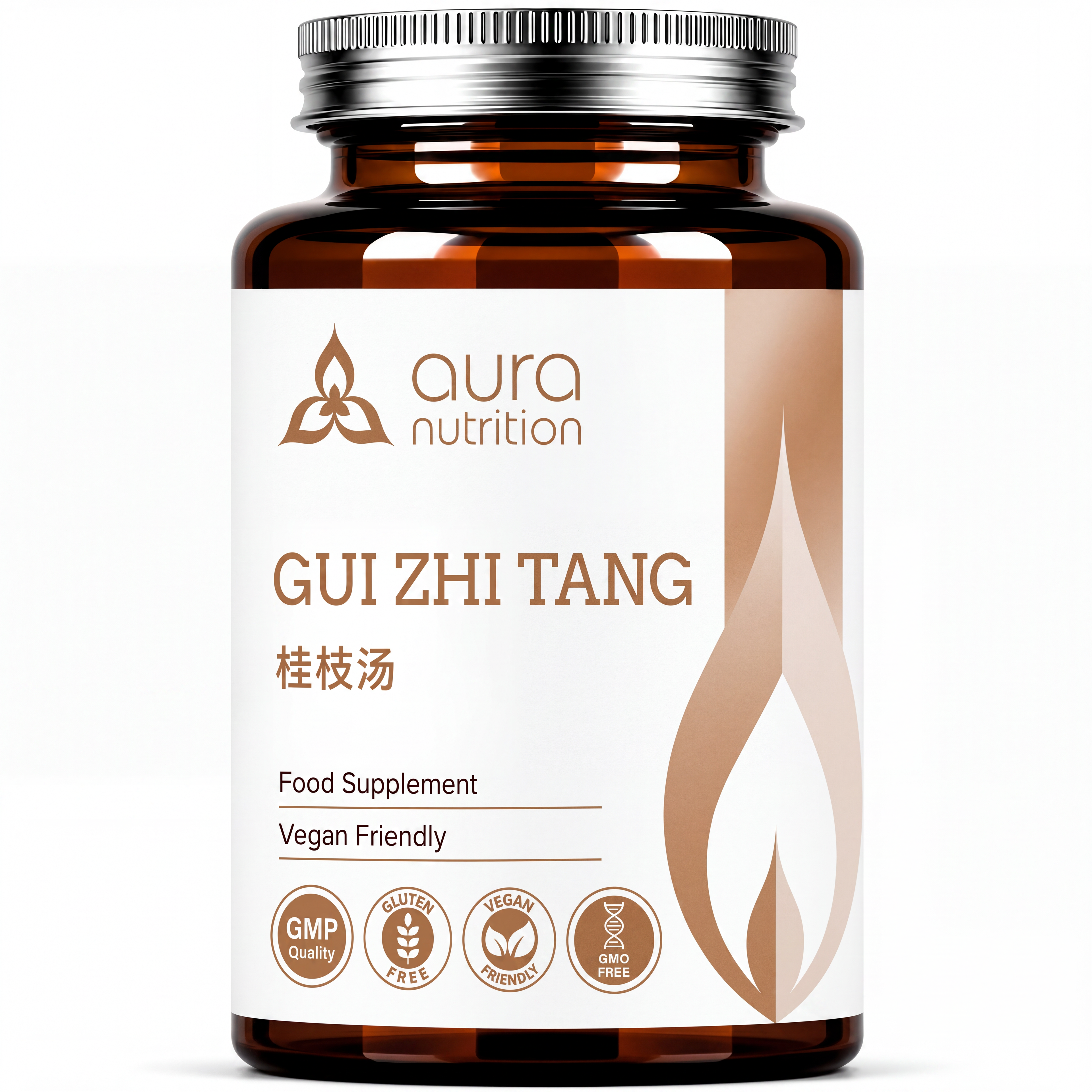
Just five kitchen-cupboard herbs: cinnamon twig, white peony, liquorice, jujube dates and fresh ginger. Made into 5:1 tablets. Four a day, so a bottle lasts fifteen days. Explore the formula
Couldn't load pickup availability
Verified Loox reviews
★★★★★
"I have had really good results with Gui Zhi Tang. Very few things help with Palmoplantar Pustullosis and it is not only unsightly but also extremely painful. It was vaguely helpful in the first couple of weeks of use and then the…"
★★★★★
"Being able to get TCM supplements from a company that is both responsive and trustworthy is really reassuring. All Aura Nutrition needs is a better delivery partner so I don't have to pester their lovely people to get Parcelforce…"
★★★★★
"Absolutely excellent in treating hormone imbalances"
Zhang Zhongjing wrote the Shang Han Lun (the 'Treatise on Cold Damage') around 200 AD, at the end of the Han dynasty. In his preface he says that more than two thirds of his large family had died within ten years, most of them from what he called cold damage. That's what drove him to write it.
Gui Zhi Tang is the first formula he gives. It's for the earliest stage of his scheme, when the trouble is still on the outside of the body. His instructions are oddly homely, too. Drink it warm, follow it with a bowl of hot thin rice porridge, wrap up, and aim for a light all-over sweat. Not a drenching one.
Later scholars called it the 'first formula of all formulas', and a huge family of recipes grows out of it. Add or swap a herb or two and you get dozens of relatives. In Japan it's known as Keishito and sits at the heart of Kampo training.
In Chinese medicine
Chinese medicine pictures two layers guarding the surface of the body. Wei Qi is the defensive layer on the very outside, and Ying Qi is the nourishing layer just beneath. When they're working together, the pores open and close as they should.
When Wind-Cold gets in, the theory goes, these two fall out of step. Wei Qi rushes outwards, Ying can't hold on, and you get that odd mix of feeling chilly while being slightly sweaty, with a stiff neck and a dislike of draughts. Zhang called this 'Taiyang wind strike'. A bit of a mouthful.
Cinnamon twig warms the outer layer and pushes outwards. White peony holds the inner layer in. One opens, one gathers, and between them they're meant to bring the two back into balance. Ginger, jujube and liquorice look after the Stomach, which in this system is where the Qi for all that comes from.
The Five Elements
The Lung sits under Metal, and in Chinese medicine the Lung governs the skin and that defensive Wei Qi. Gui Zhi Tang works right at the surface, so it's Metal country.
Autumn
When the weather turns and the first chilly winds come in. Peak Gui Zhi Tang time, traditionally.
Lung
Said to spread Wei Qi across the skin like a protective coat.
White
Metal's colour. Think frost on the grass in October.
Pungent
Cinnamon twig and fresh ginger are both pungent, the taste herbalists linked with pushing outwards.
Grief
Metal's emotion. A reminder that this system never quite separates body and feeling.
Traditional use
This is how herbalists have used it over the centuries. We're describing tradition here, not making medical claims.
The textbook picture: chilly, a little clammy, a dislike of draughts.
Chosen when the surface layers feel 'out of step', sweating without warming up.
A traditional pick in autumn and early spring, when the wind has a bite to it.
Herbalists often start from Gui Zhi Tang and adjust, which says a lot about how it's regarded.
This section describes traditional use in Chinese herbal practice. Gui Zhi Tang is a food supplement and is not intended to diagnose, treat, cure or prevent any disease.
Inside the formula · Ingredients
A tiny formula, but a very deliberate one. Each herb has a partner. Amounts are per daily serving of 4 tablets.
Chief
Cinnamon twig warms the channels and nudges the surface open. It's the herb the formula's named after. Herb Glossary
Minister
White peony is the counterweight, holding the inner Ying layer steady while cinnamon works outwards. Herb Glossary
Assistants
Fresh ginger backs up the cinnamon, and jujube backs up the peony. They also settle the Stomach. Herb Glossary
Envoy
Liquorice brings everything into harmony. There's quite a lot of it here, which matters (see the FAQs). Herb Glossary
Inactive ingredients: Cassava starch, Hypromellose, Magnesium stearate, Polyethylene glycol, Talc.
These are used in very small amounts to form and coat the tablets. They don't add to the formula itself.
How to take
Tablets with water.
Tablets with water.
Most people take a formula for several weeks.
Always follow the label. If you take any medication, are pregnant or breastfeeding, please speak to your GP or pharmacist before use.
Choosing between them
| Compare | Gui Zhi Tang | Yu Ping Feng San |
|---|---|---|
| First recorded | Han dynasty, around 200 AD | Song to Yuan era (sources differ) |
| The idea | Rebalance the two surface layers | Build up the outer defences |
| Herbs | 5, led by cinnamon twig and white peony | 3: astragalus, white atractylodes and siler |
| Character | Warming and gently outward | Steadying and strengthening |
| Often chosen when | Wind-Cold is already at the door | The 'windscreen' feels a bit thin |
In Chinese medicine terms, for Wind-Cold at the surface with Ying and Wei out of step. In plain English, that chilly, slightly clammy feeling when the weather turns. It's a food supplement, though, not a medicine.
No. It's cinnamon twig, which is the young branch rather than the bark you bake with, plus white peony, ginger, jujube and liquorice. The pairing of cinnamon and peony is the clever bit.
Zhang Zhongjing told people to follow it with hot thin rice porridge to warm the Stomach and encourage a light sweat. We can't promise you'll want porridge, but it's a lovely bit of history.
Two in the morning and two in the evening, so four a day. A bottle of 60 lasts fifteen days.
Please check with your GP first if you're pregnant, breastfeeding or on any medication. There's a fair amount of liquorice in it, and liquorice can raise blood pressure and lower potassium, so take extra care if you have high blood pressure or take blood pressure medicine, diuretics or heart medication.
They share a name and Zhang Zhongjing wrote both, but they're quite different. Gui Zhi Fu Ling Wan comes from his other book and is built around moving the Blood, not the surface.
Related formulas
Verified Loox reviews
Food supplements should not be used as a substitute for a varied, balanced diet and a healthy lifestyle. Not intended to diagnose, treat, cure or prevent any disease. Keep out of reach of children.


