

Heat inside and out
Its textbook use: Wind-Heat at the surface while Heat builds up inside too.


Traditional Chinese herbal formula
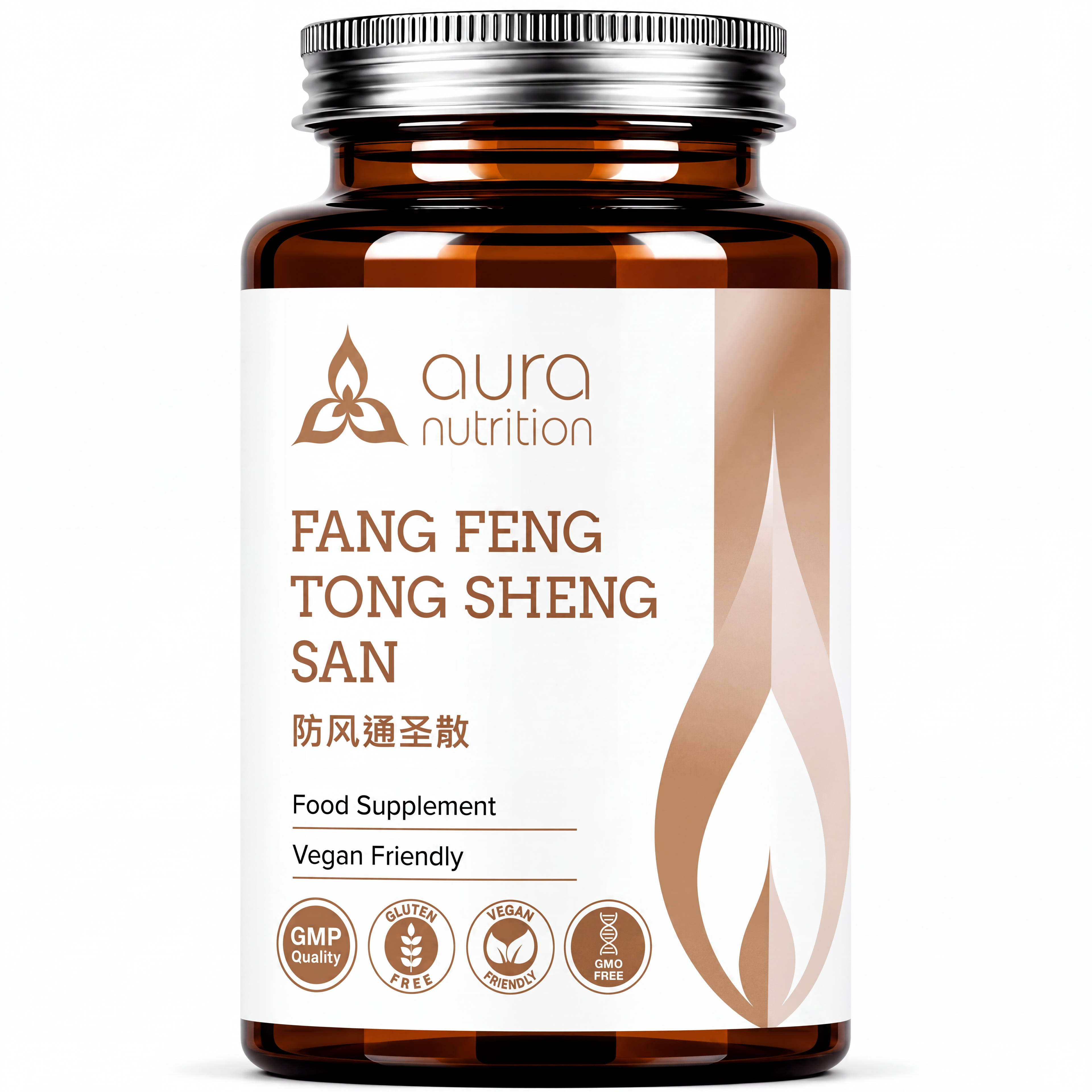
防风通圣散 · Siler & Platycodon · also known as Fang Feng Tong Sheng Wan
A big, busy formula from a doctor who thought most trouble came down to too much Heat. Fang Feng Tong Sheng San is said to clear Wind and Heat from the outside and the inside at once, so herbalists kept it for robust, hot, rather bunged-up types. Gentle it isn't.
Thirteen herbs, including siler, platycodon, skullcap, rhubarb root and liquorice. Made into 5:1 tablets. Six a day, and a bottle lasts ten days. Explore the formula
Couldn't load pickup availability
Verified Loox reviews
★★★★★
"loved it!"
Deniz T. · Video review · Verified buyer★★★★★
"Very efficient service had the item within a few days and these are a very good product"
★★★★★
"It is good when you got a cold"
Liu Wansu was a 12th-century doctor up in northern China, under the Jin dynasty, and he's counted among the four great physicians of the Jin and Yuan era. His big idea? That loads of illness came down to Heat, or Fire as he often put it. Later writers dubbed his followers the 'cold and cool school', so you can probably guess the style.
This formula came out in 1172. 'Tong sheng' usually gets translated as 'sagely unblocking', or 'works like a sage', and modest he clearly wasn't. Still, the name stuck, and people have kept using it ever since, through Ming and Qing China and over to Japan, where you'll find it as Bofutsushosan.
Liu's original had seventeen ingredients, including ephedra and three minerals (gypsum, talc and mirabilite). We've kept the thirteen herbs and dropped those four, so ours is ephedra-free.
In Chinese medicine
Most formulas choose a side, outside at the surface or inside. What Liu Wansu spotted was that sometimes it's both at once, with Wind and Heat stuck at the surface and more Heat building up within. Chinese medicine calls that an 'excess' pattern, meaning too much of something rather than too little.
The person the old herbalists had in mind is a big, solid sort who runs hot, the one down to a T-shirt in February while the rest of us are still in coats. Ruddy cheeks, always thirsty, a stuffed-up, full sort of feeling and a head like a bag of wet sand. Their skin's warm when you touch it and the bowels would rather stay put than hurry. Everything a bit bottled up, really.
So the formula throws open every exit at once, which we always picture as flinging open all the windows and the back door on a muggy August afternoon. Up at the surface you've got siler, schizonepeta and mint letting things out through the skin. Rhubarb root sends Heat out the bottom via the bowels, and gardenia takes the other route, through the urine. Cooling for the Lung and Stomach falls to skullcap, forsythia and platycodon. You might wonder what dong quai, white peony and Szechuan lovage are doing in a formula like this, and the answer is they're minding the Blood, while white atractylodes and a generous dose of liquorice sit in the middle like sandbags so all that cooling doesn't flatten things. Thirteen herbs, and honestly we couldn't find a passenger among them.
The Five Elements
Metal's the element that gets the Lung (in charge of the skin and the surface, in Chinese medicine) along with its partner, the Large Intestine, a pairing that raises eyebrows the first time most people hear it. This formula pushes on both ends of it, airing out the surface and clearing out the bowels, so you can't get much more Metal than that.
Autumn
Metal's season for letting go, and this formula's all about clearing things out. Quite fitting.
Lung
In charge of the skin, they say, and paired with the Large Intestine. Both get looked after here.
White
White goes with Metal. We think of a shirt that's just been ironed and hung on the back of the door.
Pungent
Pungent's the one. Crush a bit of raw schizonepeta or mint and you'll get it straight away, that sharp, spreading smell, and siler's in the same camp. It's meant to open the surface.
Grief
Metal's emotion, which the old texts tie to letting go. Of grief, and apparently of everything else too.
Traditional use
These are the traditional settings for Fang Feng Tong Sheng San. We're telling you what herbalists have done with it, not making medical claims.
Its textbook use: Wind-Heat at the surface while Heat builds up inside too.
Kept for strong, sturdy, hot-running folk, and never for the frail.
Picked when Heat seems to have nowhere to go, leaving you full, heavy and sluggish.
Herbalists have long reached for it when Wind-Heat was said to be showing on the surface.
This section describes traditional use in Chinese herbal practice. Fang Feng Tong Sheng San is a food supplement and is not intended to diagnose, treat, cure or prevent any disease.
Inside the formula · Ingredients
With this many herbs, it helps to think in teams. One team opens the surface, one clears Heat, one looks after the Blood and middle. Amounts are per daily serving of 6 tablets.
Chiefs
Siler and schizonepeta release Wind from the surface, and it's siler (fang feng) the formula's named after. Herb Glossary
Ministers
Mint pitches in at the surface. Then there's rhubarb root, sending Heat downwards through the bowels, and gardenia, which takes it out through the urine. Herb Glossary
Assistants
This lot's a bit of a mixed bag. Skullcap, forsythia and platycodon do the cooling, mostly for the Lung and Stomach, and then dong quai, white peony and Szechuan lovage are there for the Blood, nourishing it and keeping it moving. As for white atractylodes, its whole job is keeping the Spleen out of harm's way. Herb Glossary
Envoy
Liquorice is the biggest single herb in here. It harmonises, and stops all that cooling from upsetting the middle. Herb Glossary
Inactive ingredients: Cassava starch, Hypromellose, Magnesium stearate, Polyethylene glycol, Talc.
These are used in very small amounts to form and coat the tablets. They don't add to the formula itself.
How to take
Tablets with water.
Tablets with water.
Most people take a formula for several weeks.
Always follow the label. If you take any medication, are pregnant or breastfeeding, please speak to your GP or pharmacist before use.
Choosing between them
| Compare | Fang Feng Tong Sheng San | Tong Bian Ling Pian |
|---|---|---|
| First recorded | Jin dynasty, 1172 | 20th-century Chinese patent formula |
| The idea | Clear Wind and Heat from outside and inside | Moisten and move things along in the bowels |
| Herbs | 13, led by siler and schizonepeta | 4, led by peach kernel |
| Character | Cooling and dispersing, quite strong | Focused on the lower half |
| Often chosen when | Heat seems bottled up everywhere | The bowels are the main concern |
For what Chinese medicine calls an excess pattern of Wind and Heat, at the surface and inside at the same time. Herbalists kept it for sturdy people who run hot. It's a food supplement, though, not a medicine.
No, it doesn't. Liu Wansu's original had ephedra and three minerals in it, but ours is just the thirteen herbs, ephedra-free.
A Jin dynasty doctor from the 1100s, and one of the four great physicians of the Jin and Yuan era. He was convinced Heat sat behind a lot of illness, which is why so much of this formula is cooling.
Take three in the morning and three in the evening, and a bottle will last you ten days.
Pregnant or breastfeeding? Then this one's not for you, sorry. There's rhubarb root in it, which has a laxative action, so skip it if your bowels are on the loose side, and it isn't traditionally a long-term formula either. Dong quai doesn't mix with blood thinners like warfarin, and there's quite a bit of liquorice, which can raise blood pressure. On any medication? Please check with your GP.
Not really, no. Herbalists see it as a strong, clearing formula for robust types, not for the frail or the elderly. If you're not sure it suits you, a qualified herbalist's the one to ask.
Related formulas
Verified Loox reviews
Food supplements should not be used as a substitute for a varied, balanced diet and a healthy lifestyle. Not intended to diagnose, treat, cure or prevent any disease. Keep out of reach of children.


