

Kidney Yang deficiency
The textbook pattern, with cold, tiredness and a slowing down, especially in the lower body.


Traditional Chinese herbal formula
金匮肾气丸 · Kidney Qi Pill · also known as Shen Qi Wan, Ba Wei Di Huang Wan
One of the oldest formulas we sell, and the grandparent of the whole rehmannia family. Jin Gui Shen Qi Wan comes from Zhang Zhongjing's Golden Cabinet, written around 200 AD, and herbalists have used it ever since when the body's inner fire seems to be burning low.
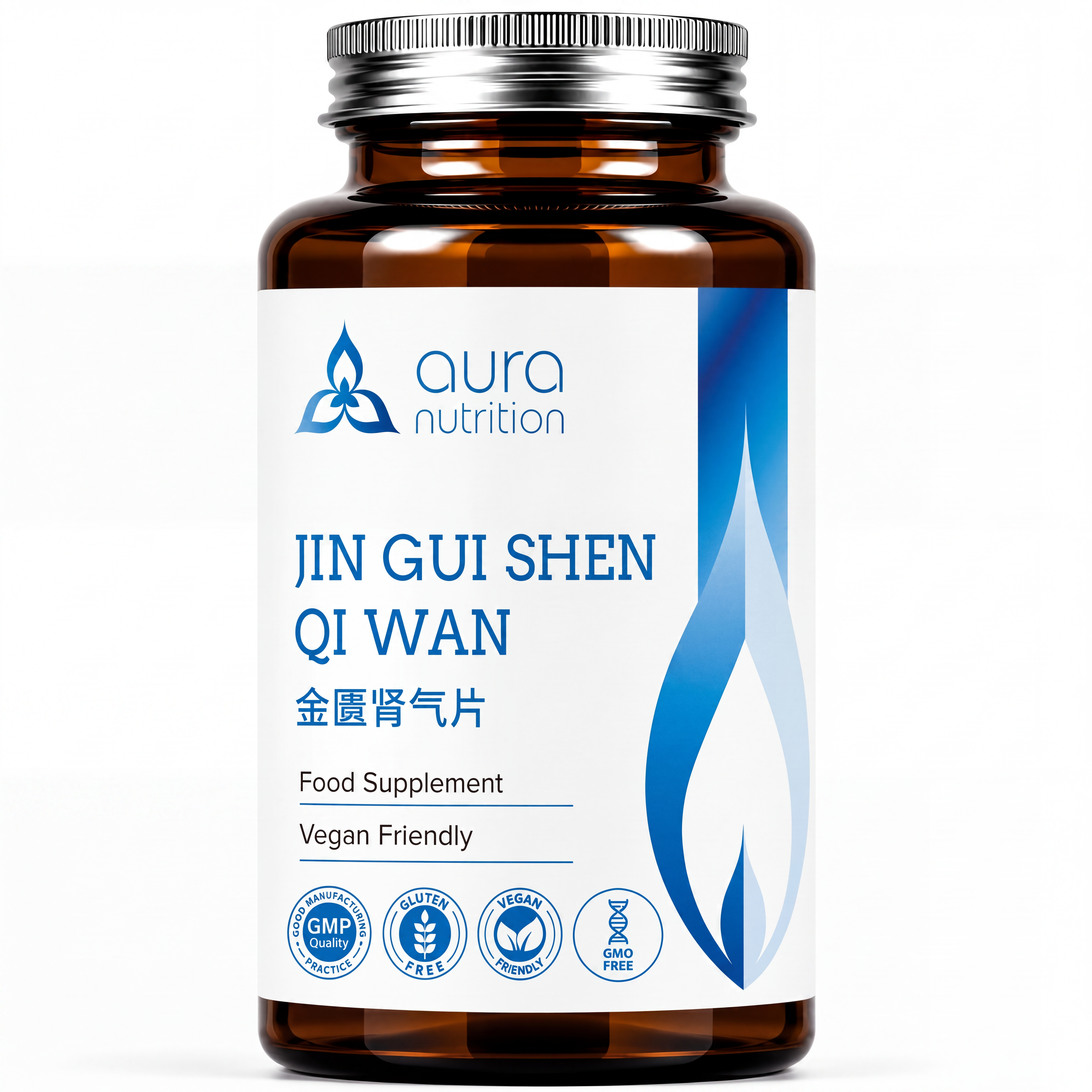
Seven herbs, led by prepared rehmannia, with cinnamon bark to bring the warmth. Made into 5:1 tablets. Six a day, so a bottle lasts ten days. Explore the formula
Couldn't load pickup availability
Verified Loox reviews
★★★★★
"I have used a similar product from another company and I find these better. The tablets are much easier to swallow and have already helped with my lower back pain, which helps with being more comfortable when sleeping. And,…"
★★★★★
"60 tablets effectively treated the rhinitis I was suffering from, and also benefited my kidney meridian in other ways."
★★★★★
"It is helping overall with bladder and kidney health"
★★★★★
"Quite rejuvenating"
★★★★★
"great product"
We owe this one to Zhang Zhongjing, a Han dynasty doctor who watched epidemic after epidemic tear through China around 200 AD (he said he lost most of his own clan to them, which is grim reading). Somewhere down the line his writing was chopped into two books. One's the Shang Han Lun. The other's the Jin Gui Yao Lue, 'Essentials from the Golden Cabinet', and that's where we found this. Hence 'Jin Gui'. (You'll also see it written Jin Kui, as in our web address. Same characters, different reading.)
The original recipe had eight ingredients, which is why it's also called Ba Wei Di Huang Wan, Eight Ingredient Rehmannia. Two of the eight were warming: cinnamon and fu zi, prepared aconite root. Aconite isn't allowed in UK supplements, so our version leaves it out and relies on cinnamon bark for the warmth.
Around 1119, the Song physician Qian Yi took this formula and removed the two warming herbs to make something gentler for children. That became Liu Wei Di Huang Wan, Six Ingredient Rehmannia. So, in a sense, a whole family of famous formulas started right here.
In Chinese medicine
Right, a bit of theory. The Kidneys hold two kinds of reserve in Chinese medicine, Yin (cool, nourishing) and Yang, which we always explain to customers as the pilot light on an old boiler. When that little flame's going, the theory says the whole house stays warm and the water side of things keeps moving. When it splutters, well, you notice.
So what happens when that pilot light dims? The old texts describe someone who's always feeling the cold, mostly in the lower back and knees, who's up in the night for the loo and just feels a bit slower all round. That's classic Kidney Yang deficiency. It tends to be a getting-older picture, though younger people turn up with it too.
The clever bit is that this formula doesn't just pile on heat. The bulk of it is rehmannia, cornus and Chinese yam, there to nourish, and then a smaller dose of cinnamon bark goes on top. It's a bit like putting a match to a grate that's already stacked with logs, rather than chucking a match on bare stone. Poria, water plantain and tree peony bark stop it getting stodgy or overheated.
The Five Elements
The Kidneys belong to Water, the element of winter. Water is about what's stored deep down, and the old idea is that a bit of fire in the Water keeps the whole system warm.
Winter
Water's season, and the time of year Kidney Yang is said to be tested most.
Kidney
Paired with the Bladder, and seen as the root of both warmth and coolness in the body.
Black
Prepared rehmannia, the chief herb, is steamed until it's almost jet black.
Salty
Salt is said to lead herbs to the Kidneys. Old-school practitioners had people wash their Kidney pills down with lightly salted water.
Fear
Water's emotion in the classical system. Not a bad thing in moderation. It keeps us careful.
Traditional use
Here's where Jin Gui Shen Qi Wan has traditionally been used. All of this is historical use, not a medical claim.
The textbook pattern, with cold, tiredness and a slowing down, especially in the lower body.
Herbalists chose it for people who feel the chill in their back, knees and feet more than anyone else in the room.
Long used as a later-life formula, especially in Japan, where it's one of the best-known Kampo prescriptions.
Some practitioners lean on it most in the colder half of the year.
This section describes traditional use in Chinese herbal practice. Jin Gui Shen Qi Wan is a food supplement and is not intended to diagnose, treat, cure or prevent any disease.
Inside the formula · Ingredients
The classic court structure, with rehmannia on the throne. Amounts are per daily serving of 6 tablets.
Chief
Prepared rehmannia, in the biggest amount, nourishes the Kidneys and gives the warmth something to work with. Herb Glossary
Ministers
Cornus and Chinese yam add more nourishment. Cinnamon bark is the warm spark. Herb Glossary
Assistants
Poria and water plantain drain fluids, and tree peony bark stops any heat building up. They keep a rich formula light on its feet. Herb Glossary
Inactive ingredients: Cassava starch, Hypromellose, Magnesium stearate, Polyethylene glycol, Talc.
These are used in very small amounts to form and coat the tablets. They don't add to the formula itself.
How to take
Tablets with water.
Tablets with water.
Most people take a formula for several weeks.
Always follow the label. If you take any medication, are pregnant or breastfeeding, please speak to your GP or pharmacist before use.
Choosing between them
| Compare | Jin Gui Shen Qi Wan | Liu Wei Di Huang Wan |
|---|---|---|
| First recorded | Han dynasty, around 200 AD | Song dynasty, 1119 |
| The idea | Nourish the Kidneys and warm Kidney Yang | Nourish Kidney Yin |
| Herbs | 7, including cinnamon bark | 6, with no warming herbs |
| Character | Warming | Neutral to slightly cool |
| Often chosen when | You feel the cold and run low | You run low and a bit warm |
Both. The second character can be read either way, so you'll see both spellings. We use Jin Kui in our web address and Jin Gui on the label. Same formula.
This is the original, with warming cinnamon. Liu Wei is the later version with the warmth taken out. Herbalists pick this one if you feel the cold, Liu Wei if you don't.
The original recipe has fu zi (prepared aconite), but aconite can't be sold in UK food supplements, so that's that. We get the warmth from cinnamon bark instead, which smells a lot nicer anyway.
Three in the morning, three in the evening, so six tablets a day. You'll get ten days out of a bottle.
Not for everyone, no. This is a warm one, so if you're the type who's always throwing the duvet off, thirsty and a bit red in the face, or you're down with a cold or a temperature right now, a herbalist would point you somewhere else. Expecting, breastfeeding or taking medication? Give your GP a ring before you start. And if you've got liver problems, bear in mind that cinnamon bark in large amounts isn't ideal.
Traditionally it's a slow, steady formula, taken over weeks rather than days. If you're thinking long term, a chat with a qualified practitioner is a good idea.
Related formulas
Verified Loox reviews
Food supplements should not be used as a substitute for a varied, balanced diet and a healthy lifestyle. Not intended to diagnose, treat, cure or prevent any disease. Keep out of reach of children.


