

Kidney Qi not holding
This is the textbook pattern, the one where the Kidney gate's thought to have gone a bit loose.


Traditional Chinese herbal formula
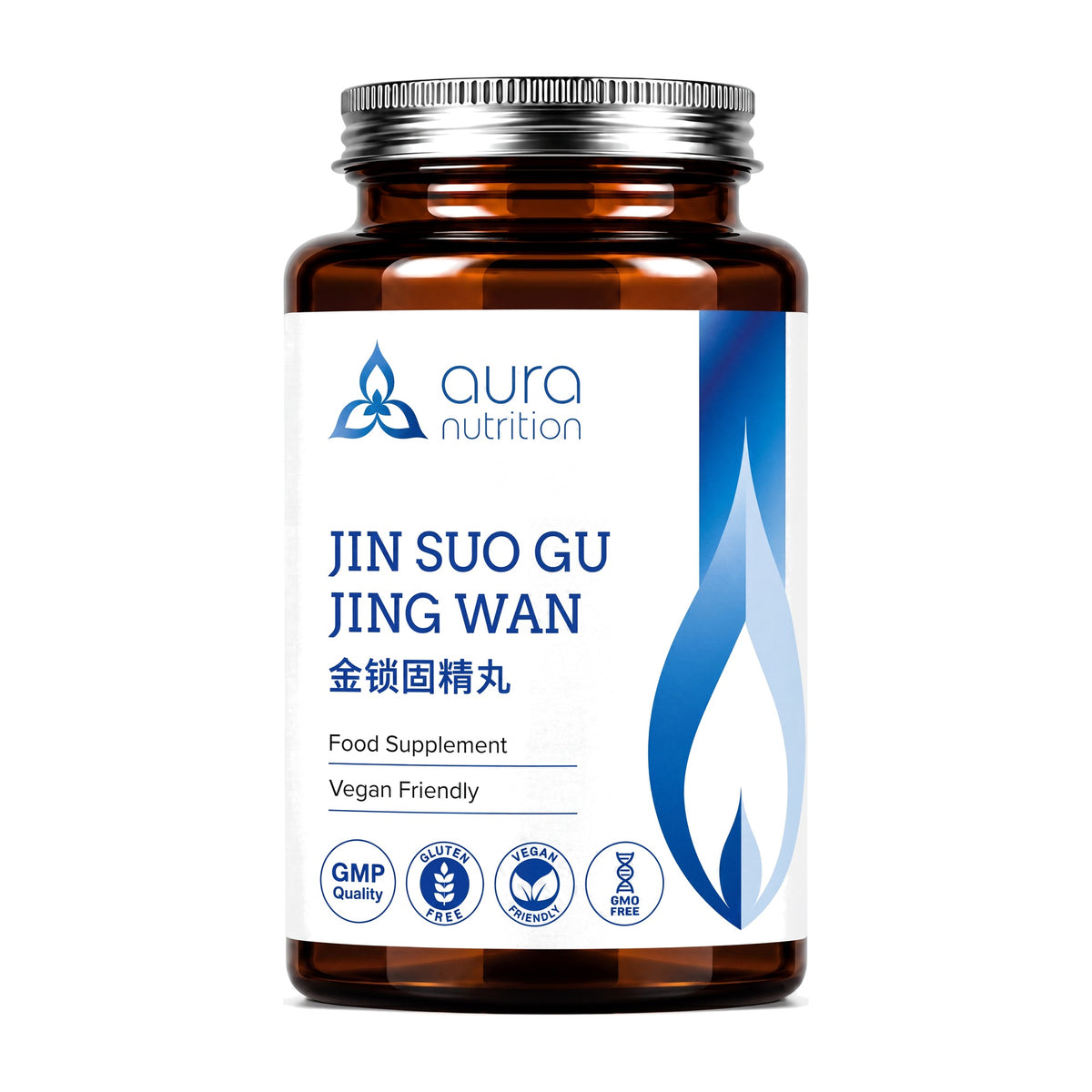
金锁固精丸 · Golden Lock · also known as Golden Lock Pill to Secure the Essence
Jin Suo Gu Jing Wan means 'golden lock pill to secure the Essence', which tells you exactly what herbalists thought it was for. Keeping things in. In Chinese medicine the Kidneys are meant to hold on to your deepest reserves, and this is the classic idea for when that grip feels loose.
Our version is led by a big dose of lotus seed, with astragalus, lotus seed heart, schisandra, sharp-leaf galangal fruit and Chinese raspberry. Six herbs, 5:1 tablets, six a day. A bottle lasts ten days. Explore the formula
Couldn't load pickup availability
Verified Loox reviews
★★★★★
"Has helped me a lot, but would need to keep taking it for longer to see long term benefits"
★★★★★
"Thankyou easy to take Penny"
★★★★☆
"I've been taking Gui Zhi Fu Ling Wan for about 7 weeks (3 pills, twice/day) for a large (12cm+ fibroid). I believe the minimum recommended time to take is 30 days and I'm past that. My fibroid may have reduced a little (no more…"
★★★★★
"Amazing product, I had been so ill for 8 weeks, constantly nauseous, couldn’t stomach food & had zero energy, within 2 days of taking these tablets I was full of energy & my appetite returned. I highly recommend."
★★★★☆
"Very easy order and overnight delivery. Very carefully packaged. Well presented and prepared product. Now beginning to take effect... Excellent to have such a wide range of Chinese medicines easily available."
★★★★☆
"I've been using Bu Zhong Yi Qi for just over a week, and I’m already noticing positive changes in my overall well-being. Most noticeably, it seems to be supporting my hormonal balance—I’ve felt more emotionally steady, with…"
You can thank Wang Ang for the name. He was a Qing dynasty scholar, and in 1682 he put out Yi Fang Ji Jie, which was more or less an annotated greatest hits of formulas, pitched at ordinary educated readers and not court physicians. The golden lock was one of his picks.
His version leaned hard on seeds and shells: flattened milkvetch seed, euryale, lotus stamen, dragon bone and oyster shell, all rolled up in lotus seed paste. Astringency was the whole point. Think of a drawstring bag being pulled tight and you've got the gist.
Ours is a modern take, and yes, the line-up's different from the old recipe (it's all on the label, so no nasty surprises). Lotus seed is still sitting right there in the middle. Around it we've now got astragalus, schisandra and a couple of the classic Kidney fruits. Think of it as the same old lock with a newer key cut for it.
In Chinese medicine
Right, the short version. According to Chinese medicine your Kidneys hold on to something called Jing (Essence), the reserve you're born with, which sits behind growing up, fertility and getting older. We tend to explain it in the shop as a deep battery. Spend it too freely and the bank balance drops. That's about it, honestly.
The Kidneys were also given a sort of 'gate', meant to open and shut at the right moments. If Kidney Qi runs low, the story goes, that gate gets slack and lets out things that ought to stay in. Old texts call it Kidney Qi not consolidating (bit of a mouthful), and it's the exact picture the golden lock was made for.
So who's doing what? Lotus seed and schisandra are your astringent pair, the ones that hold. Astragalus is there to lift and firm up Qi, while sharp-leaf galangal fruit and Chinese raspberry are old Kidney favourites. And the lotus seed heart, which tastes faintly bitter, is meant to settle the Heart, because a calm Heart and a shut gate go together in this way of thinking.
The Five Elements
Kidneys sit under Water in the Five Elements, and Water's season is winter. It's all storage and stillness, a reserve lying deep down and waiting its turn. You can see why a lock fits rather nicely.
Winter
Winter's for hunkering down and conserving, which is pretty much this formula's whole personality.
Kidneys
Their partner organ's the Bladder. As the theory goes, the Kidneys look after Essence and make sure that gate stays shut when it ought to.
Black
Black, or a very dark blue, like deep water on a long winter night. Dried schisandra berries go a lovely dark shade too, funnily enough.
Salty
Salty is Water's flavour. Schisandra's the oddball, said to carry all five tastes at once (its name literally means five-flavour seed).
Fear
Fear's supposed to drain the Kidneys in this system, which is partly why the lotus seed heart's in here to steady things.
Traditional use
What follows is how herbalists have reached for the golden lock over the centuries. It's tradition we're describing, so please don't read it as a health claim.
This is the textbook pattern, the one where the Kidney gate's thought to have gone a bit loose.
In the old books especially, you'll find it filed among the best-known Kidney formulas for men.
Herbalists picked it when reserves felt low and it seemed like things were slowly slipping away.
And when a busy, whirring mind seemed to come along for the ride, that's where the lotus seed heart earns its place.
This section describes traditional use in Chinese herbal practice. Jin Suo Gu Jing Wan is a food supplement and is not intended to diagnose, treat, cure or prevent any disease.
Inside the formula · Ingredients
Our golden lock has one big chief herb and a small supporting cast, each picked to steady or hold. Amounts are per daily serving of 6 tablets.
Chief
Lotus seed gets the biggest dose by a mile. It's seen as gently astringent and nourishing for both Spleen and Kidneys, and it's mild enough that people in China cook with it in sweet soups. Herb Glossary
Ministers
Astragalus is the one that firms up Qi. Then there's schisandra, the classic astringent berry, sour and a bit resinous on the tongue. Together they keep the lock good and tight. Herb Glossary
Assistants
Sharp-leaf galangal fruit brings warmth to the Kidneys, and Chinese raspberry's a traditional 'holding' fruit. Lotus seed heart? That's the tiny green sprout tucked inside each seed, and it's there to settle the Heart. Herb Glossary
Inactive ingredients: Cassava starch, Hypromellose, Magnesium stearate, Polyethylene glycol, Talc.
These are used in very small amounts to form and coat the tablets. They don't add to the formula itself.
How to take
Tablets with water.
Tablets with water.
Most people take a formula for several weeks.
Always follow the label. If you take any medication, are pregnant or breastfeeding, please speak to your GP or pharmacist before use.
Choosing between them
| Compare | Jin Suo Gu Jing Wan | Wu Zi Yan Zong Wan |
|---|---|---|
| First recorded | Name from Qing dynasty, 1682 | Ming dynasty, 1500s |
| The idea | Hold Essence in, firm up Kidney Qi | Build Kidney Essence back up |
| Herbs | 6, led by lotus seed | 5 seeds and berries, led by dodder and goji |
| Character | Astringent, steadying | Nourishing, gently warming |
| Often chosen when | Things feel loose and leaky | Reserves feel low and need topping up |
It's poetry, mostly. The idea was to lock in Essence, the deep reserve Chinese medicine says the Kidneys look after, and calling it golden just tells you it's a very good lock.
Same name and idea, but the recipe's changed. Wang Ang used seeds and shells like euryale and oyster shell, whereas ours keeps the lotus seed and brings in astragalus, schisandra and three other herbs. You'll find every one of them on the label.
In the history books it's mostly shown up in men's formulas, sure. But the pattern behind it, Kidney Qi that won't hold, doesn't belong to anyone in particular.
You'd take three in the morning and another three in the evening, so six a day, and that makes a 60-tablet bottle last ten days.
On any prescription medicine? Then a quick word with your GP or pharmacist first, please, as schisandra and astragalus can both interact with certain drugs (including some that people take after a transplant). If you're pregnant or breastfeeding, same again: check with your GP first, as you would with any herbal supplement.
Because they're two parts of one seed, and they do different jobs. The seed's sweet and gentle, while the little green heart inside is properly bitter and herbalists use it to calm the Heart. Waste not, want not.
Related formulas
Verified Loox reviews
Food supplements should not be used as a substitute for a varied, balanced diet and a healthy lifestyle. Not intended to diagnose, treat, cure or prevent any disease. Keep out of reach of children.


