

Wound-up and tight
The textbook choice for stuck Liver Qi, when the tension feels physical as well as emotional.


Traditional Chinese herbal formula
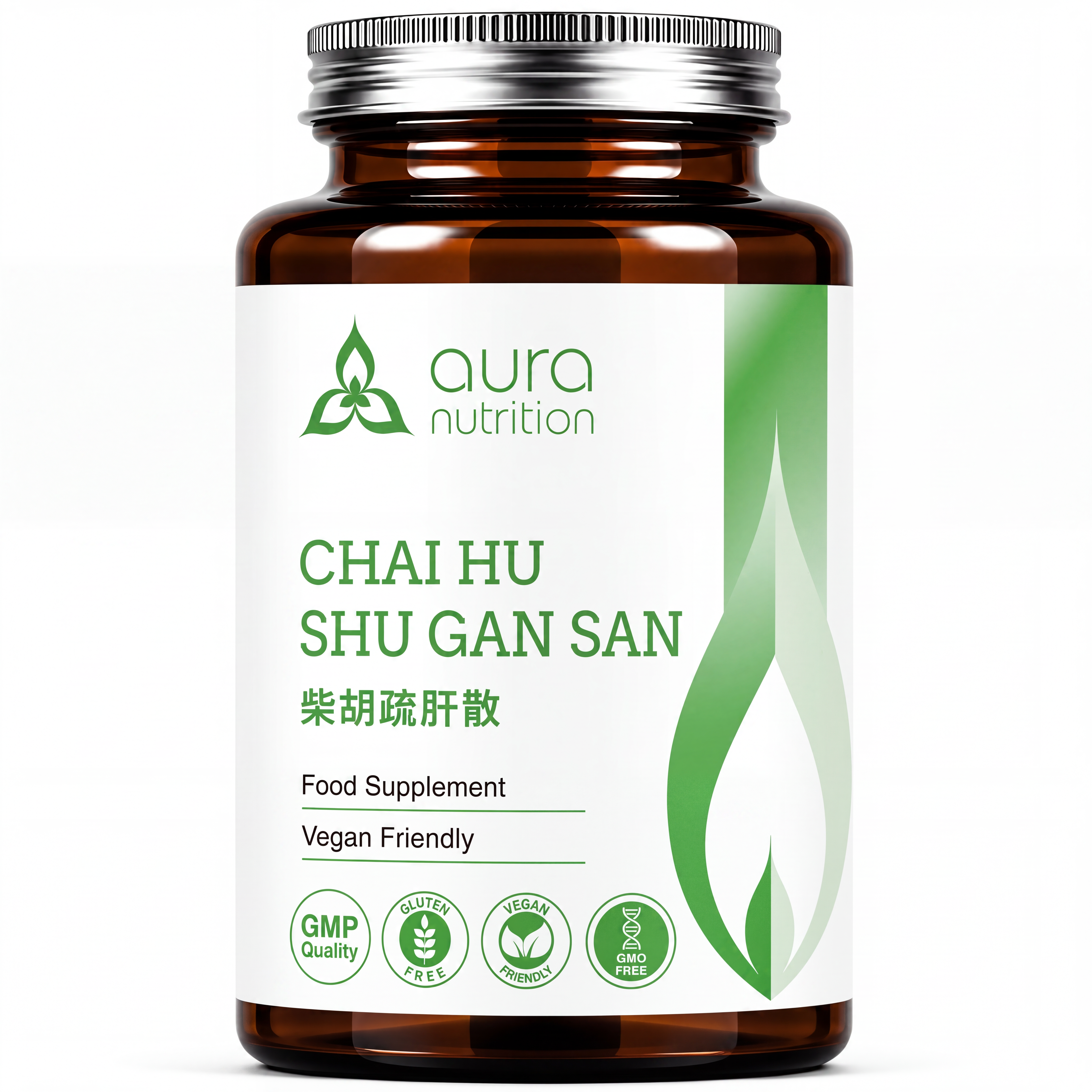
柴胡疏肝散 · Bupleurum & Orange Peel · also known as Chai Hu Shu Gan Wan
If Xiao Yao San is the gentle way to get stuck Qi moving, Chai Hu Shu Gan San is the brisk one. The name means 'bupleurum powder to soothe the Liver', and herbalists picked it when tension had settled in properly: tight ribs, lots of sighing, a knot that just won't shift.
Seven herbs, led by bupleurum, with tangerine peel, cyperus and Sichuan lovage to keep things moving. Made into 5:1 tablets. Six a day, and a bottle lasts ten days. Explore the formula
Couldn't load pickup availability
Verified Loox reviews
★★★★☆
"Found these herbal tablets to be really helpful for my stress and anxiety that I have been experiencing. Feeling a lot calmer than I have ushally thought. I will be definitely ordering more. 😌"
★★★★★
"Great customer service and great product"
★★★★★
"This supplement has really helped me. I started with night sweats following a partial hysterectomy and they have reduced dramatically! My energy levels are also picking up gradually. I don’t quite take the full dose as yet as I…"
★★★★★
"Not happy with the 126mg of Hydroxypropylmethylcellulose per tablet 😢 but these pills are miraculous! I’ve only taken these capsules for 12 days and can already feel and see, that my uterus has shrunk (fibroids). I am now a…"
★★★★☆
"I've been taking Gui Zhi Fu Ling Wan for about 7 weeks (3 pills, twice/day) for a large (12cm+ fibroid). I believe the minimum recommended time to take is 30 days and I'm past that. My fibroid may have reduced a little (no more…"
★★★★★
"Amazing product, I had been so ill for 8 weeks, constantly nauseous, couldn’t stomach food & had zero energy, within 2 days of taking these tablets I was full of energy & my appetite returned. I highly recommend."
The roots go back to Si Ni San, a tiny four-herb formula in Zhang Zhongjing's Shang Han Lun from around 200 AD. Bupleurum, peony, liquorice and a citrus herb. Short, simple, very effective at what it set out to do.
In the Ming dynasty, physicians built on it. Chai Hu Shu Gan San is best known from Zhang Jingyue's huge Jing Yue Quan Shu, published in 1624, though he was quoting a slightly earlier Ming source. The new version added cyperus, Sichuan lovage and tangerine peel, which tipped the balance firmly towards moving things on.
It's become the textbook formula for Liver Qi stagnation in Chinese colleges. Ask a student of Chinese herbalism to name one, and there's a decent chance this is the first thing they'll say.
In Chinese medicine
The Liver, in Chinese medicine, keeps Qi flowing freely. Its channel runs up the sides of your body and under the ribs, so if Qi gets stuck, that's where you tend to notice it, a tight, puffed-out sort of feeling round the sides that seems to come and go with your mood.
Herbalists would call it Liver Qi stagnation, plain and simple. It's not really about tiredness (that's Xiao Yao San territory), it's tension and pressure. Lots of sighing. A short fuse. The sense of something being wedged.
Bupleurum's in charge, and its whole thing is letting the Liver off the leash. Cyperus, which is a knobbly, hairy little rhizome with a warm, spicy smell, does the Qi side with tangerine peel. Blood tends to get stuck alongside, so Sichuan lovage is there for that. Then you've got white peony and liquorice taking the edge off, because all that shoving about could feel a bit much otherwise. Finger citron adds a fragrant, gentle push of its own.
The Five Elements
The Liver belongs to Wood, and Wood is all about growing freely. Think of a branch that keeps bending round an obstacle. Chai Hu Shu Gan San is about clearing the obstacle.
Spring
Wood's season. Stuck Liver Qi is said to show up more as the year turns.
Liver
Paired with the Gallbladder. Their channels run along the sides of the body, right where this formula is aimed.
Green
Wood's colour, and the colour of unripe citrus peel too.
Sour
White peony root brings sourness, and the old recipe fried the tangerine peel in vinegar for more.
Anger
The emotion most tied to stuck Liver Qi. Pent-up frustration is the classic example.
Traditional use
Here's where Chai Hu Shu Gan San turns up most in the old books and in clinics today. Traditional use only, to be clear. These aren't medical claims.
The textbook choice for stuck Liver Qi, when the tension feels physical as well as emotional.
Herbalists chose it when tension seemed to collect under the ribs, along the Liver channel.
When worry seems to go straight to the tummy, with bloating and burping that come and go with mood.
An old, very recognisable sign of stuck Qi, and one this formula is closely linked with.
This section describes traditional use in Chinese herbal practice. Chai Hu Shu Gan San is a food supplement and is not intended to diagnose, treat, cure or prevent any disease.
Inside the formula · Ingredients
A classic court with bupleurum in charge. Amounts are per daily serving of 6 tablets.
Chief
Bupleurum frees up the Liver. It's in the name, after all. Herb Glossary
Ministers
Cyperus moves Liver Qi and Sichuan lovage moves the Blood, so between them they back bupleurum up. Herb Glossary
Assistants
Tangerine peel and finger citron move Qi through the middle. White peony softens the Liver and keeps all that movement from feeling too sharp. Herb Glossary
Envoy
Liquorice teams up with white peony to relax tension, and ties the formula together. Herb Glossary
Inactive ingredients: Cassava starch, Hypromellose, Magnesium stearate, Polyethylene glycol, Talc.
These are used in very small amounts to form and coat the tablets. They don't add to the formula itself.
How to take
Tablets with water.
Tablets with water.
Most people take a formula for several weeks.
Always follow the label. If you take any medication, are pregnant or breastfeeding, please speak to your GP or pharmacist before use.
Choosing between them
| Compare | Chai Hu Shu Gan San | Si Ni San |
|---|---|---|
| First recorded | Ming dynasty, best known from 1624 | Han dynasty, around 200 AD |
| The idea | Move stuck Liver Qi firmly, and the Blood with it | Release stuck Qi, gently and simply |
| Herbs | 7, including cyperus and Sichuan lovage | 4: bupleurum, peony, citrus peel and liquorice |
| Character | Stronger, more moving | Simple and light |
| Often chosen when | Tension is well set in, with tightness at the sides | Things have only just started to feel stuck |
Both start with bupleurum. Xiao Yao San adds Blood and Spleen herbs, so herbalists use it when tension comes with tiredness. Chai Hu Shu Gan San is more focused on moving Qi, for when tension is the main story.
Fo shou, or 'Buddha's hand', a fragrant citrus fruit that splits into finger-like segments. It's used in Chinese herbalism to move Qi gently. The classic recipe has bitter orange in its place.
Three tablets in the morning and three in the evening. One bottle lasts ten days.
If you take anything regularly, please check with your GP first. There's liquorice in it, and liquorice can push blood pressure up and bring potassium down, so if your blood pressure's on the high side or you're taking diuretics (water tablets), we'd say this isn't really the one for you. Same goes if you're pregnant or breastfeeding, sorry, because Sichuan lovage moves the Blood.
Herbalists traditionally see it as a formula for a stuck patch rather than forever, because moving herbs can feel a bit drying over time. Many then switch to something gentler like Xiao Yao San.
Two of the seven herbs are citrus: tangerine peel and finger citron. Moving Qi tends to call for fragrant herbs. It's a nice side effect, frankly.
Related formulas
Verified Loox reviews
Food supplements should not be used as a substitute for a varied, balanced diet and a healthy lifestyle. Not intended to diagnose, treat, cure or prevent any disease. Keep out of reach of children.


