

Damp-Heat Bi
Here's the core pattern, with Damp and Heat thought to be stuck in the channels around the joints.


Chinese patent herbal formula
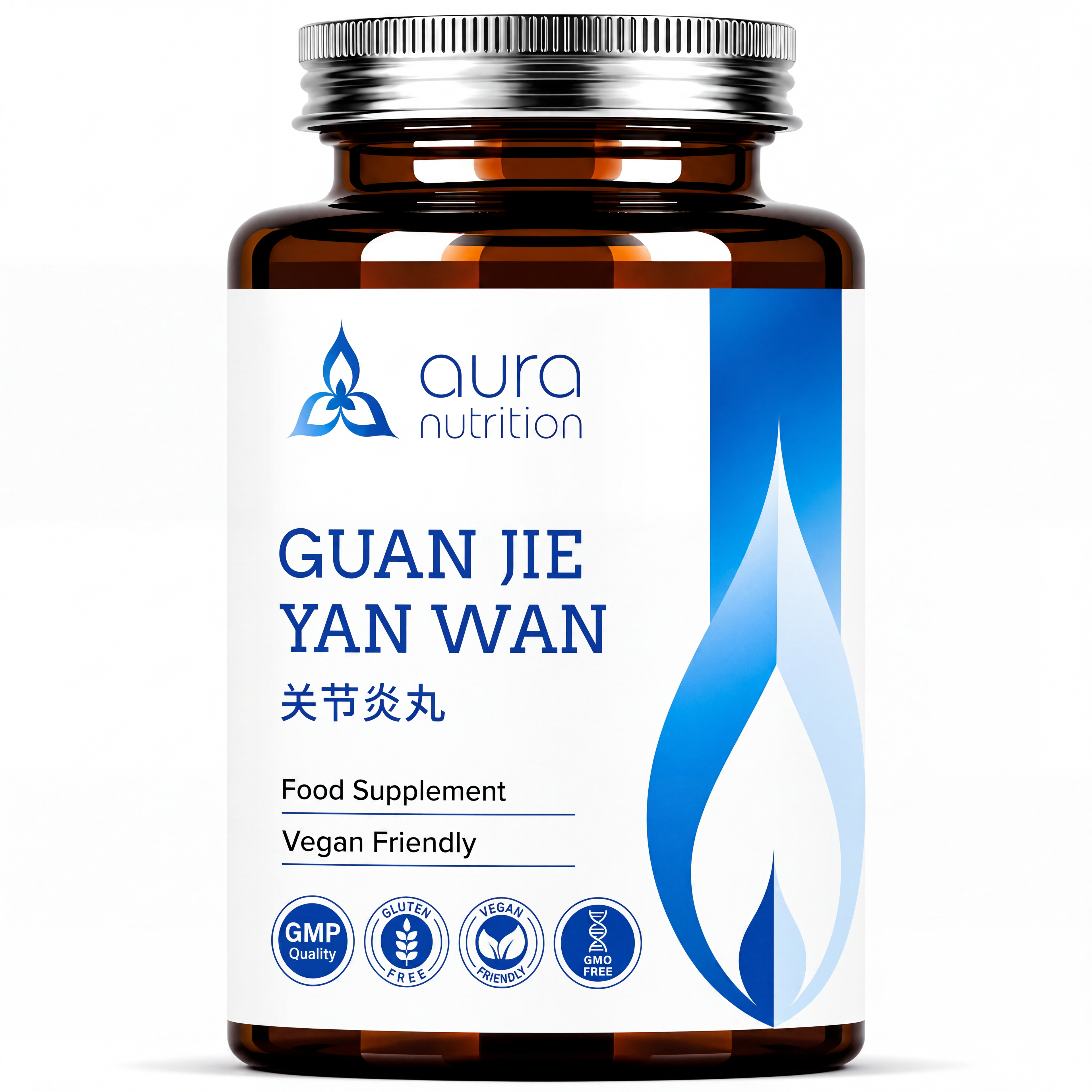
关节炎丸 · Mulberry Twig & Job's Tears · also known as
Guan Jie Yan Wan is a modern Chinese pharmacy formula built around the joints, or what Chinese medicine calls the channels that run through them. Herbalists picture Wind, Damp and Heat getting lodged there. Stiff, heavy, a bit warm to the touch? That's the old picture.
Eleven herbs, led by mulberry and Job's tears, with white atractylodes, cinnamon twig, turmeric and more. Made into 5:1 tablets, four a day, so a bottle lasts fifteen days. Explore the formula
Couldn't load pickup availability
Verified Loox reviews
★★★★★
"excellent service by Aura Nutrition and excellent product"
★★★★★
"I bought this to help with chronic Yin deficiency symptoms, including persistent urinary tract irritation, dragging fatigue, and poor sleep. Since starting these tablets, I’ve felt a noticeable improvement—my kidney energy feels…"
★★★★★
"Recommended these by my acupuncturist for better hormone balance and liver detoxification. I felt better within a few of days of using the Wen Jin Tang - uplifted, more relaxed, happier, sleeping better. Highly recommend this…"
★★★★★
"I bought Wen Jing Tang since I started to bleed between periods. Quite amazed to find that bleeding stopped after 2 days of taking this medication."
★★★★★
"I was having issues with migraines and anger. And a beautiful TICM doctor suggested me this. Since taking the tablets along side my hydrogen, Alkaline water I have so much energy and my head feels amazing. It has definitely…"
★★★★★
"Quick and easy ordering process! Taste fine and does the job perfectly would recommend!"
Let's get this out of the way: it isn't ancient. Guan Jie Yan Wan is a Chinese patent formula, one of those ready-made pills the state pharmacies standardised at some point in the 20th century, so there's no famous author to name and no dynasty to wave about.
We like how plain the name is. Guan jie just means the joints, and then there's yan (炎), which is literally two fire characters (火) stacked one on the other. Not subtle, is it? It tells you straight away the formula leans to the hot side.
The thinking underneath is far older, mind you. Chinese doctors have been writing about Bi, or 'obstruction', since the Han dynasty, picturing Wind, Cold, Damp or Heat lodged in the channels so Qi and Blood can't move freely. This formula takes the Damp-Heat flavour of that idea and throws eleven well-known herbs at it.
In Chinese medicine
Bi's one of those words that won't translate neatly, though 'obstruction' gets you most of the way. Picture Wind and Damp creeping in from outside, settling into the channels round the joints and just staying there, so where Qi and Blood ought to flow you get stiff and heavy instead.
Damp's the sticky one. It loves to hang about, and leave it long enough and it's said to heat up, so you end up with Damp-Heat Bi, which feels heavy, puffy and warm. British weather can't be helping (honestly, the old Chinese doctors would've had a field day with a wet February in Manchester).
Mulberry and Job's tears are out in front. Job's tears drains Damp, and the mulberry tree's long been tied to clearing Wind. Backing them up you've got white atractylodes, working through the Spleen, which this system says should stop Damp forming in the first place. Then gentian, skullcap and Japanese knotweed cool things down, while cinnamon twig, turmeric, pubescent angelica and cyathula get it all moving and steer the formula out to the arms and legs.
The Five Elements
Damp belongs to Earth, the element of late summer and the Spleen. Herbalists reckon that when Earth's out of kilter, Damp piles up and goes heavy on you, and shifting that is precisely what this formula's for.
Late summer
Humid, sticky, close weather. You know the sort. It's when Damp's supposed to be at its worst.
Spleen
It pairs with the Stomach and is meant to transform Damp, plus it's in charge of the muscles and all four limbs.
Yellow
Earth's colour, and turmeric's doing its bit there, as anyone who's ever spilled it on a worktop will tell you.
Sweet
Job's tears and white atractylodes both taste mild and sweetish, which is just how the Spleen likes it.
Worry
Overthinking's said to wear down the Spleen. Mulling things over at 3am, basically.
Traditional use
This is how Chinese herbalists have traditionally used the formula. Think of it as background on tradition, not a claim about what it'll do for your health.
Here's the core pattern, with Damp and Heat thought to be stuck in the channels around the joints.
Picked for those days when your arms and legs feel weighed down and slow to get started.
A favourite once the season turns wet and muggy and everything feels a touch waterlogged.
Lots of our customers who stay on the move, walkers and gardeners in particular, like having it in their routine.
This section describes traditional use in Chinese herbal practice. Guan Jie Yan Wan is a food supplement and is not intended to diagnose, treat, cure or prevent any disease.
Inside the formula · Ingredients
Patent formulas don't always follow the classical court structure strictly, but this one maps on fairly well. Amounts are per daily serving of 4 tablets.
Chief
Mulberry and Job's tears take the lead. Mulberry's linked with clearing Wind, and Job's tears, those plump pearly grains you'll sometimes see in Chinese soups, is the classic for draining Damp. Herb Glossary
Ministers
White atractylodes dries Damp by way of the Spleen. Cinnamon twig, cyathula and pubescent angelica are your movers, pushing things along the channels and out to the limbs. Herb Glossary
Assistants
Gentian and Baikal skullcap? Bitter and cooling, and gentian especially is about as bitter as herbs get. Japanese knotweed and turmeric are there to keep Blood moving. Herb Glossary
Envoy
Fresh ginger's kind to the stomach, and it takes the edge off all those cold, bitter herbs. Herb Glossary
Inactive ingredients: Cassava starch, Hypromellose, Magnesium stearate, Polyethylene glycol, Talc.
These are used in very small amounts to form and coat the tablets. They don't add to the formula itself.
How to take
Tablets with water.
Tablets with water.
Most people take a formula for several weeks.
Always follow the label. If you take any medication, are pregnant or breastfeeding, please speak to your GP or pharmacist before use.
Choosing between them
| Compare | Guan Jie Yan Wan | Du Huo Ji Sheng Tang |
|---|---|---|
| First recorded | 20th-century Chinese patent formula | Tang dynasty, around 650 |
| The idea | Clear Damp and Heat from the channels | Clear Wind and Damp, and nourish Kidneys and Liver |
| Herbs | 11, led by mulberry and Job's tears | 14, led by pubescent angelica |
| Character | Cooling | Warming and building |
| Often chosen when | Things feel heavy, stiff and warm | Stiffness is long-standing, with cold and tiredness |
Guan jie's the joints, wan's a pill, and yan is written as two fire characters piled on top of each other, which is a fairly heavy hint at the Heat it's aimed at, in Chinese medicine terms.
The herbs are, and so's the idea of Bi. The formula itself though is a 20th-century Chinese patent recipe, not something lifted from an ancient book, and we'd rather tell you that straight.
Two in the morning and two in the evening, so four a day, and a bottle will see you through fifteen days.
Roughly speaking, a herbalist would reach for Guan Jie Yan Wan when things feel heavy and warm, and Du Huo Ji Sheng Tang when they feel cold, long-standing and worn out. Not sure which you are? A practitioner can help you work it out.
Not in pregnancy, please. Cyathula, turmeric and Japanese knotweed all move Blood, so steer clear if you're pregnant, trying to conceive or breastfeeding. On blood thinners like warfarin? Then turmeric and knotweed aren't for you either. And if you take any regular medication at all, have a quick word with your GP or pharmacist first.
Gentian and skullcap are seriously bitter and cold, and a pinch of fresh ginger is the old trick for keeping your stomach on side with a mix like that.
Related formulas
Verified Loox reviews
Food supplements should not be used as a substitute for a varied, balanced diet and a healthy lifestyle. Not intended to diagnose, treat, cure or prevent any disease. Keep out of reach of children.


