

Knotted-up Qi
The core pattern is constraint, where Qi and Blood feel bunched up and tight.


Chinese patent herbal formula
解郁安神片 · Calm the Spirit · also known as
Jie Yu An Shen Pian roughly means 'untie the knots, settle the Spirit'. It's a modern Chinese formula built on an old hunch: that when Qi and Blood get stuck in the body, the Shen (the spirit, or mind) can't settle either. Tight shoulders, busy head.
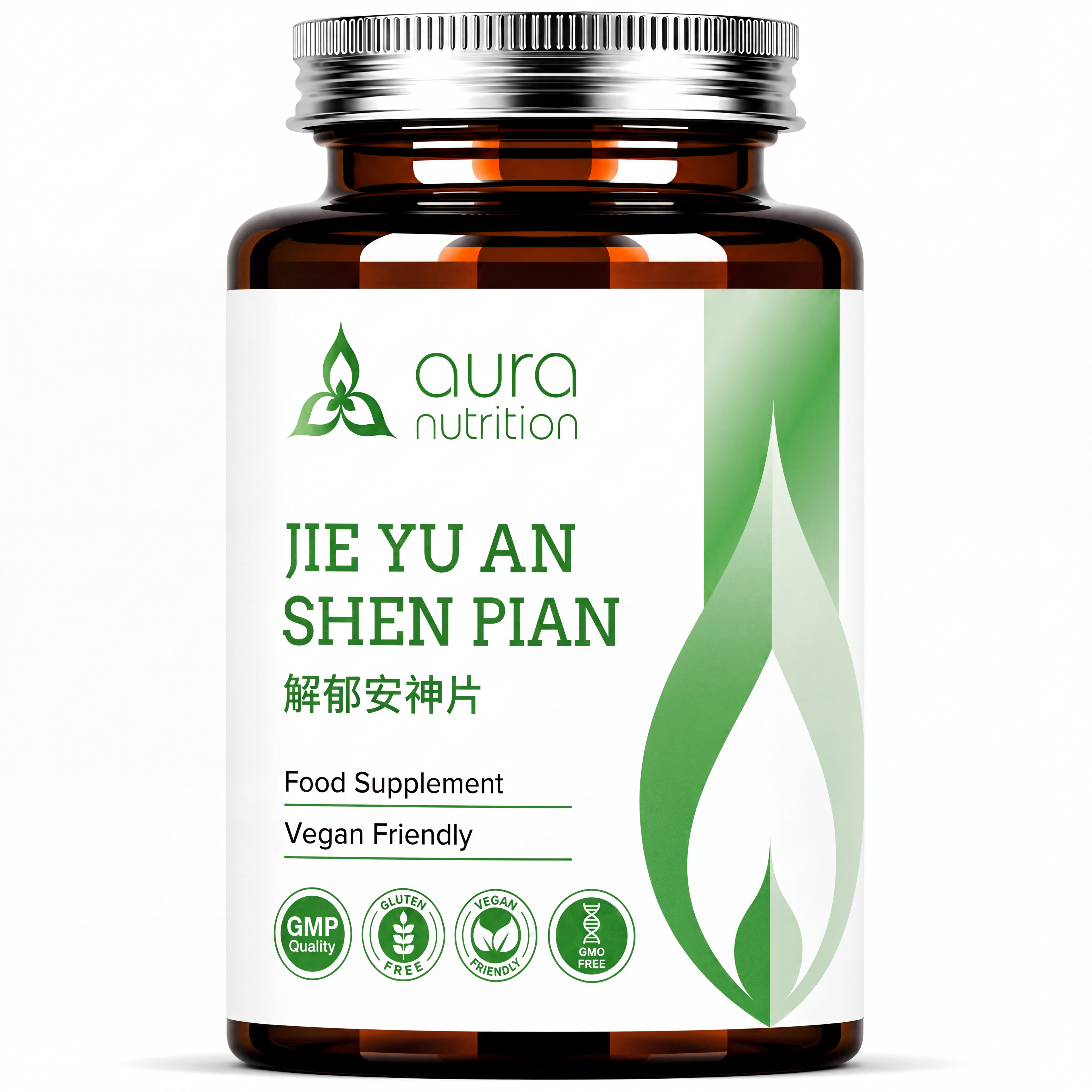
Fourteen herbs, with silk tree bark and fo-ti vine at the centre and a strong supporting cast of moving herbs like frankincense and myrrh. Made into 5:1 tablets. Six a day, and a bottle lasts ten days. Explore the formula
Couldn't load pickup availability
Verified Loox reviews
★★★★☆
"I love the fact that there is a bona fides medical test done showing the cooperation between the medicine that I take, and the Jie yu An Shen. I can truly say I have noticed a difference."
★★★★★
"Feel so much better"
★★★★★
"Slowly introduced. No obvious immediate effects. After 2 weeks. I realise life is calmer. Anxiety lessened, joy is there. I feel like me. I will continue. I am taking 2 in the morning and 2 in the evening. I will increase to the…"
★★★★★
"I run The Menopause Herbalist - an on-line service supporting women in navigating peri-menopause and menopause symptoms. I recommend Aura Nutrition to all my patients as I have observed over the last few years the significant…"
★★★★★
"This supplement has really helped me. I started with night sweats following a partial hysterectomy and they have reduced dramatically! My energy levels are also picking up gradually. I don’t quite take the full dose as yet as I…"
★★★★★
"Not happy with the 126mg of Hydroxypropylmethylcellulose per tablet 😢 but these pills are miraculous! I’ve only taken these capsules for 12 days and can already feel and see, that my uterus has shrunk (fibroids). I am now a…"
We'll say it plainly: this is a 20th-century Chinese patent formula, made as a standard tablet and not taken from any classical book. Its two lead herbs, on the other hand, have stories that go back a couple of thousand years.
Silk tree bark, He Huan Pi, translates as 'bark of collective happiness', and the Shen Nong Ben Cao Jing (China's oldest herbal) said it settled the organs and left people 'joyful and free of worry'. Then there's the fo-ti vine, Shou Wu Teng, also called Ye Jiao Teng, the 'night-joining vine', supposedly because its stems twine together after dark. Charming, if botanically a bit doubtful.
The rest of it owes a debt to Wang Qingren, the Qing doctor who wrote Yi Lin Gai Cuo in 1830. His argument was that stuck Blood could unsettle the mind, which was a pretty fresh angle back then, and corydalis, frankincense and myrrh sit squarely in that tradition.
In Chinese medicine
'Yu' is a word you'll hear a lot in Chinese medicine circles. It means constraint, the idea being that stuff which should be flowing (Qi and Blood, mostly) gets bunched up and stuck. When people try to put it into words they say things like knotted, or tight across the chest and shoulders, or they notice they keep sighing and can't say why.
Now, the Heart. According to the classics it's where the Shen lives, and Shen translates loosely as spirit or mind (translators argue about this endlessly). If the Heart's short of Blood that moves freely, the Shen has nowhere comfy to settle, hence that restless, can't-switch-off feeling. So the logic runs like this: free things up and the mind tends to follow.
Silk tree bark and fo-ti vine are the settlers. Corydalis, frankincense, myrrh and tree peony bark get Qi and Blood going, with white peony there to soften things. Eucommia, cyathula, cinnamon twig, kadsura stem, siler and peucedanum ease the channels, and liquorice ties the whole thing up. Quite a crowd, we know, but every one of them's got a job.
The Five Elements
The Heart sits under Fire, summer's element, and Fire's all about warmth, connection and a nice steady flame. Herbalists say that when it starts flickering about, the Shen gets restless.
Summer
Fire's season brings long light evenings, which aren't always the easiest for winding down.
Heart
It's said to house the Shen, and silk tree bark and fo-ti vine are both classic Heart herbs.
Red
Fire's colour, and fittingly the silk tree has these fluffy pink-red flowers that look a bit like powder puffs.
Bitter
That's Fire's taste, and corydalis and tree peony bark bring plenty of it.
Joy
It's the Heart's emotion. And silk tree bark's Chinese name literally means collective happiness, so that fits.
Traditional use
Here's where herbalists have traditionally used this sort of formula. Read it as tradition and background, please, and not as medical claims.
The core pattern is constraint, where Qi and Blood feel bunched up and tight.
Picked when the mind just won't settle, in the Chinese medicine sense of a Spirit with nowhere to rest.
Herbalists chose it when stress seemed to camp out in the shoulders, chest or back.
That night-joining vine's been an evening herb in Chinese practice for a very long time.
This section describes traditional use in Chinese herbal practice. Jie Yu An Shen Pian is a food supplement and is not intended to diagnose, treat, cure or prevent any disease.
Inside the formula · Ingredients
Laid out like a Chinese royal court: two chiefs, a busy set of ministers and assistants, and one envoy. Amounts are per daily serving of 6 tablets.
Chief
Silk tree bark and fo-ti vine are what herbalists turn to when they want to settle the Shen. Herb Glossary
Ministers
Corydalis, frankincense, myrrh and tree peony bark are your movers for Qi and Blood. White peony's the gentle one, softening and nourishing. Herb Glossary
Assistants
This lot ease the channels: eucommia and cyathula look after the lower body, cinnamon twig and kadsura stem see to the limbs, and siler and peucedanum clear and lift. Herb Glossary
Envoy
Liquorice keeps a long formula in harmony and rounds off its sharper edges. Herb Glossary
Inactive ingredients: Cassava starch, Hypromellose, Magnesium stearate, Polyethylene glycol, Talc.
These are used in very small amounts to form and coat the tablets. They don't add to the formula itself.
How to take
Tablets with water.
Tablets with water.
Most people take a formula for several weeks.
Always follow the label. If you take any medication, are pregnant or breastfeeding, please speak to your GP or pharmacist before use.
Choosing between them
| Compare | Jie Yu An Shen Pian | Te Xiao An Mian Pian |
|---|---|---|
| First recorded | 20th-century Chinese patent formula | 20th-century Chinese patent formula |
| The idea | Free stuck Qi and Blood so the Shen can settle | Nourish and cool the Heart to settle the Shen |
| Herbs | 14, including frankincense and myrrh | 8, including red sage and schisandra |
| Character | Moving, gently warming | Calming, slightly cooling |
| Often chosen when | The tension feels physical, held in the body | The mind runs hot and busy |
Jie means to untie, yu's constraint, an is to settle and shen's the spirit. So you end up with something like 'untie the knots, settle the Spirit'.
Same plant, different bit of it. Shou Wu Teng is the vine and He Shou Wu is the root, and herbalists use the vine mostly for the Heart and the root mostly for Blood and Essence.
No, sorry. There are five herbs in here that move Blood (frankincense, myrrh, corydalis, cyathula and tree peony bark), and that's not something you want while pregnant, trying to conceive or breastfeeding, so we'd leave this one on the shelf.
Best to ask your GP or pharmacist before starting, really, because there are a few things in here they'll want to know about. Corydalis might add to the effect of sedatives. If you're on warfarin or another blood thinner, give the Blood-moving herbs a miss. There's a fair bit of liquorice too, which isn't ideal if you've high blood pressure. Oh, and fo-ti vine comes from the same plant as fo-ti root, which the UK MHRA has warned about for rare liver reactions, so leave it if you've got liver problems.
You'd take three in the morning and three in the evening, six a day all told, and one bottle lasts ten days.
They share the same two lead herbs. A herbalist would lean towards Jie Yu An Shen Pian when the tension's sitting in the body, and Te Xiao An Mian Pian when it's more of a warm, busy head. Still stuck? Just ask us.
Related formulas
Verified Loox reviews
Food supplements should not be used as a substitute for a varied, balanced diet and a healthy lifestyle. Not intended to diagnose, treat, cure or prevent any disease. Keep out of reach of children.


