

Blood stasis
Its defining use: Blood said to be sluggish and pooling, with fixed, stabbing aches.


Traditional Chinese herbal formula
桃红四物汤 · Peach Kernel & Safflower Four Substances · also known as Jia Wei Si Wu Tang
Si Wu Tang with a push. Take the classic four-root Blood formula, add peach kernel and safflower, and you get Tao Hong Si Wu Tang. Herbalists reach for it when Blood is said to be both thin and stuck, the sort of picture where things feel sluggish, dark and a bit achy.
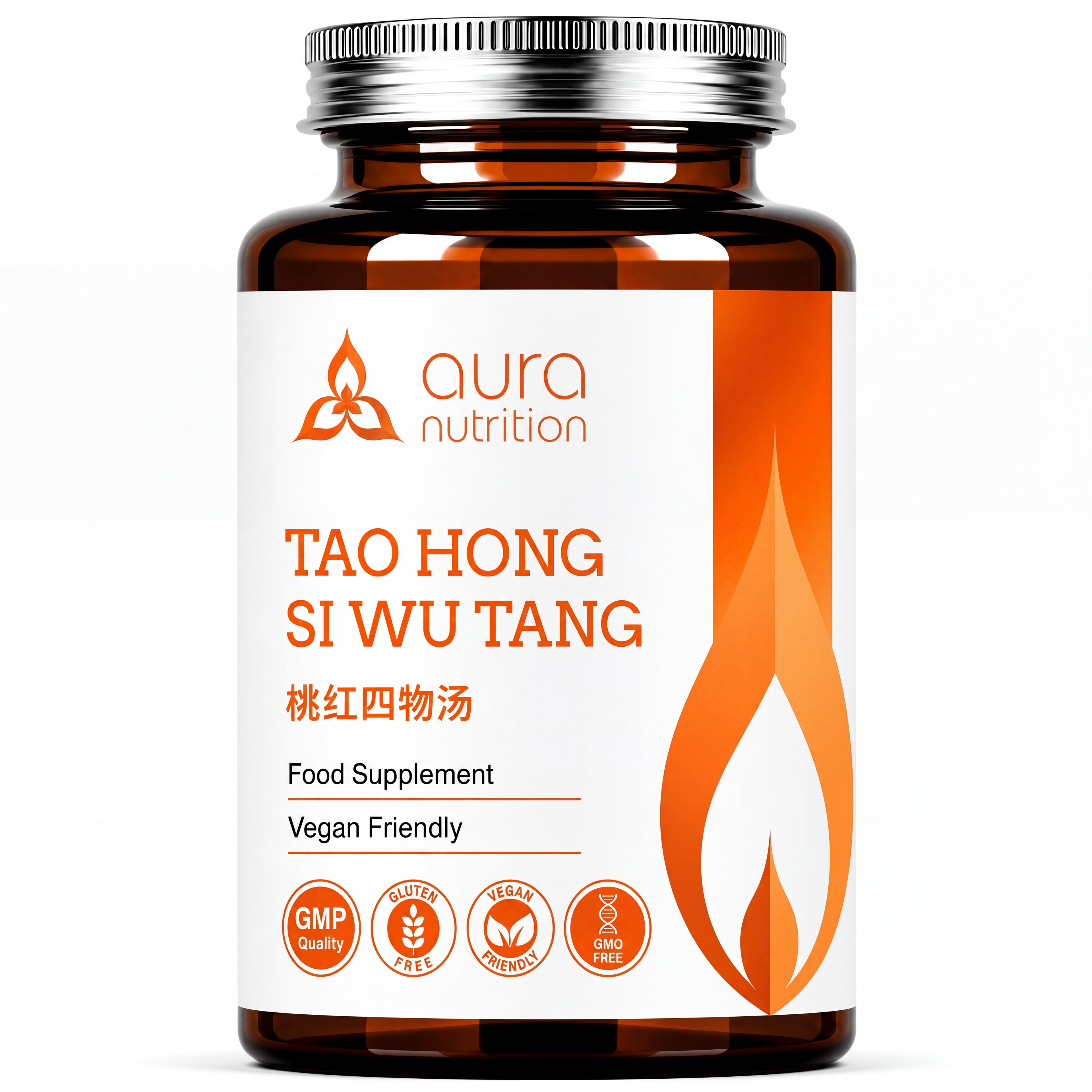
Six herbs: rehmannia, dong quai, white peony, Szechuan lovage, peach kernel and safflower. Made into 5:1 tablets, six a day. Not for pregnancy. Explore the formula
Couldn't load pickup availability
Verified Loox reviews
★★★★★
"Excellent product"
Jaqueline N. · Video review · Verified buyer★★★★★
"So far I’m loving the herbs, feeling so much more balanced. Been taking for less than a month so looking forward to the longer term improvements."
★★★★★
"Great product, I felt a difference within the first week. Will keep using this I think for the foreseeable future."
★★★★★
"Great"
Everything starts with Si Wu Tang, the Four Substances, which made it into the Song government's official formulary around 1110. Doctors spent the next few centuries fiddling with it, a herb here, a herb there, and one of the handiest tweaks they came up with was adding peach kernel and safflower.
An early version is credited to Wang Haogu, a 13th-century doctor who'd studied under Li Dongyuan, and he called it, rather unglamorously, Jia Wei Si Wu Tang ('Four Substances with added flavours'). Today's name was settled in 1742 in the Yi Zong Jin Jian, a vast medical encyclopaedia the Qianlong Emperor had commissioned.
As for the name, 'tao' is peach and 'hong' is red, from hong hua, safflower. It's basically a shopping list, then. Two new herbs on a famous base, job done.
In Chinese medicine
Blood, in Chinese medicine, has to be plentiful and it has to keep moving. Too little and you've got Blood deficiency, and if it slows down and pools, that's Blood stasis. They often turn up together, the theory says, because thin Blood doesn't get round very well.
Herbalists describe Blood stasis as a fixed, stabbing sort of discomfort that stays put, a darker or purplish tinge to the lips or tongue, and a monthly flow that's dark, clotted or slow to start. Throw in the pale, tired signs of deficiency and there's your Tao Hong picture.
The four base herbs nourish the Blood and nudge it along gently. Peach kernel and safflower are far firmer about it, breaking up stasis so fresh Blood can come through. (Safflower's those thin, spiky orange-red petals, by the way, a bit like a scruffy saffron.) Nourishing and circulating in one go, which explains why it's such a staple.
The Five Elements
The Liver stores the Blood and keeps it flowing smoothly, and it sits under Wood. So when Blood stagnates, Wood can't really do its job, and that's the connection.
Spring
Wood's growing season, when the sap starts rising and moving.
Liver
Keeper of the Blood, they say, making sure it flows smooth and even.
Green
Wood's colour, though safflower would much rather you noticed the red.
Sour
That's white peony's sourness, which herbalists say helps the Liver keep hold of the Blood.
Anger
Stuck Blood and stuck feelings often go hand in hand, or so herbalists reckon.
Traditional use
This is how herbalists have traditionally used Tao Hong Si Wu Tang. Take it as history and tradition, please, not as medical claims.
Its defining use: Blood said to be sluggish and pooling, with fixed, stabbing aches.
Picked when the pale, tired look of thin Blood shows up alongside signs of stasis.
A classic when the flow was described as dark, clotted and slow to get going.
Herbalists have long reached for Blood-moving formulas when bumps and knocks leave things stuck.
This section describes traditional use in Chinese herbal practice. Tao Hong Si Wu Tang is a food supplement and is not intended to diagnose, treat, cure or prevent any disease.
Inside the formula · Ingredients
The Four Substances form the base, and the two famous additions give the formula its edge. Amounts are per daily serving of 6 tablets.
Chiefs
Peach kernel and safflower are the whole reason this formula exists. Both move the Blood firmly and break up stasis. Herb Glossary
Ministers
Rehmannia and dong quai nourish the Blood, so the formula's building as well as moving. Herb Glossary
Assistants
White peony nourishes and softens the Liver, and Szechuan lovage gets Qi and Blood both on the move. Herb Glossary
Inactive ingredients: Cassava starch, Hypromellose, Magnesium stearate, Polyethylene glycol, Talc.
These are used in very small amounts to form and coat the tablets. They don't add to the formula itself.
How to take
Tablets with water.
Tablets with water.
Most people take a formula for several weeks.
Always follow the label. If you take any medication, are pregnant or breastfeeding, please speak to your GP or pharmacist before use.
Choosing between them
| Compare | Tao Hong Si Wu Tang | Si Wu Tang |
|---|---|---|
| First recorded | 1200s, named in the Qing dynasty | Tang dynasty, then the Song formulary around 1110 |
| The idea | Nourish the Blood and get it moving | Nourish the Blood |
| Herbs | 6: the base four plus peach kernel and safflower | 4: rehmannia, dong quai, white peony, Szechuan lovage |
| Character | Nourishing with a push | Gentle and nourishing |
| Often chosen when | Depletion comes with signs of Blood stasis | The picture is mainly pale and depleted |
For what Chinese medicine calls Blood stasis with Blood deficiency, where the Blood's said to be both thin and sluggish. That's tradition talking. Ours is a food supplement, not a medicine.
Same four herbs, plus peach kernel and safflower, which move the Blood a good deal more strongly. If you want the gentler, more nourishing one, that's Si Wu Tang.
No, sorry. Peach kernel and safflower are traditional Blood-movers and they're avoided in pregnancy, and we'd say the same if you're trying to conceive or breastfeeding. Herbalists also steer clear when the monthly flow's already heavy.
Dong quai, safflower and peach kernel shouldn't be mixed with blood thinners like warfarin, or with aspirin, and it's best to stop before any surgery. On any regular medicine at all? Then do check with your GP or pharmacist first.
Three in the morning, three in the evening. That way a bottle of 60 lasts you ten days.
'Tao' is peach (kernel) and 'hong' is red, short for hong hua or safflower. Tack on 'Si Wu Tang', the Four Substances, and you've got it. About as literal as names come.
Related formulas
Verified Loox reviews
Food supplements should not be used as a substitute for a varied, balanced diet and a healthy lifestyle. Not intended to diagnose, treat, cure or prevent any disease. Keep out of reach of children.


