

Qi and Blood
Its classic use: building Blood by first building up the Qi that makes it.


Traditional Chinese herbal formula
当归补血汤 · Astragalus & Dong Quai · also known as Dong Quai Blood Tonic
Two herbs, and a lovely bit of logic. Dang Gui Bu Xue Tang is named after dong quai and means 'dong quai decoction to build Blood', yet it's about five parts astragalus to one part dong quai. The idea, from the great 13th-century doctor Li Dongyuan, is that Qi makes Blood. So you build the Qi first.
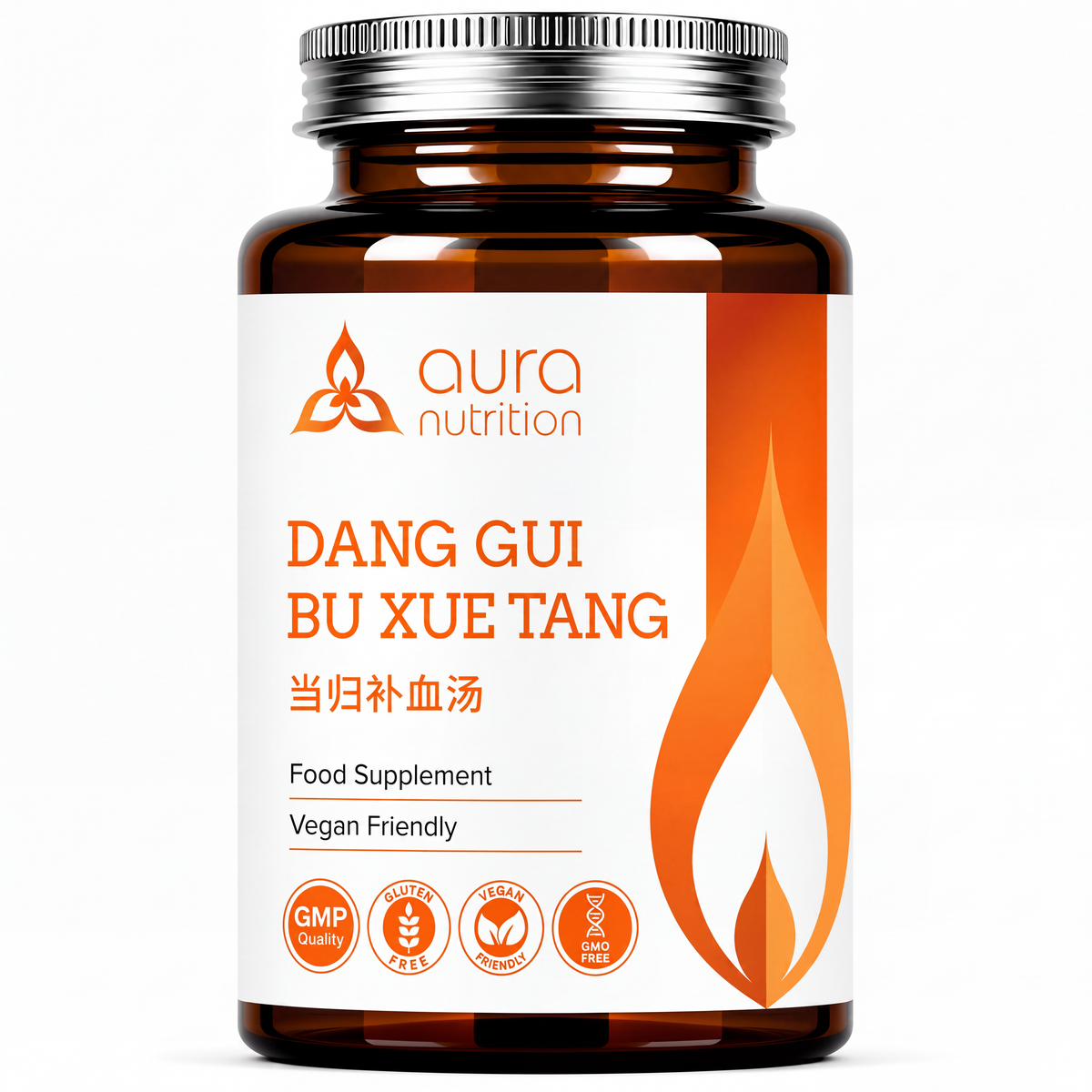
Astragalus and dong quai, roughly five to one, made into 5:1 tablets. Six a day, and a bottle lasts ten days. Explore the formula
Couldn't load pickup availability
Verified Loox reviews
★★★★★
"Amazing"
★★★★☆
"Very easy order and overnight delivery. Very carefully packaged. Well presented and prepared product. Now beginning to take effect... Excellent to have such a wide range of Chinese medicines easily available."
★★★★☆
"I've been using Bu Zhong Yi Qi for just over a week, and I’m already noticing positive changes in my overall well-being. Most noticeably, it seems to be supporting my hormonal balance—I’ve felt more emotionally steady, with…"
★★★★★
"I have suffered from prolapse for years and it was better after using one bottle of this product. I am using a second bottle now and the condition is improving."
★★★★★
"Have been recommended to help me restore my sleep and it has been really useful."
★★★★☆
"I take 3 pills in the morning and 3 in the evening and is have improved my sleep 😴"
Li Dongyuan (Li Gao, if we're being proper) lived through some grim times. Northern China in the early 1200s was torn up by war, and he watched sieges leave people starved and worn to nothing. He came round to the view that a weakened Spleen and Stomach sat behind much of what he was seeing, and went on to found what we now call the Spleen and Stomach school.
Dang Gui Bu Xue Tang came out in 1247, in his book on telling illness from outside apart from inner exhaustion. He'd spotted that some worn-out people ran hot, flushed and thirsty, a bit like a fever, when underneath they were simply depleted. Cool them down and you'd only make matters worse, he said. Build them up instead.
His recipe was one liang of astragalus to two qian of dong quai, which comes out at five to one, and ours lands at almost exactly that ratio. Seven and a half centuries later, it's still the textbook example of 'Qi generates Blood'.
In Chinese medicine
Our favourite line on this comes from the old texts, and we've got it pinned above the packing bench: Qi commands the Blood, Blood is Qi's mother. In plain English, Qi's what makes Blood, pushes it round and keeps it in its lane, while Blood quietly feeds the Qi back, so the two are stuck with each other. Want more Blood, then? Often the quickest road there runs through Qi.
Li Dongyuan had a very particular picture in mind: someone exhausted by over-work, hunger or blood loss, who feels hot, flushed and thirsty, yet whose pulse feels big and empty underneath. It looks like a heat pattern, he warned, and it isn't. That's depletion showing through on the surface. Clever, and a little counter-intuitive.
Astragalus is the heavy lifter, strengthening Spleen and Lung Qi so the body has what it needs to make Blood. It's a long, fibrous, sweetish root, and sliced it looks a bit like a pale yellow tongue depressor. Dong quai, in a much smaller amount, nourishes the Blood itself and moves it gently. Two herbs, one idea, sized just right.
The Five Elements
Li Dongyuan built his whole school around Earth, the Spleen and Stomach, which turn food into Qi and Blood in this system. Unsurprisingly, his best-known Blood formula starts there too.
Late summer
Earth's season, when the harvest's in and the stores are filling up.
Spleen
Li Dongyuan's favourite organ, said to make Qi and Blood out of whatever you eat.
Yellow
Earth's colour. Cut through an astragalus root and it's pale yellow inside.
Sweet
Both herbs taste sweet, which herbalists link with building up the Spleen.
Worry
Earth's emotion. Li Dongyuan reckoned worry and over-work wore the Spleen down. Fair enough.
Traditional use
These are the traditional ways herbalists have used Dang Gui Bu Xue Tang. We're talking history and tradition here, not medical claims.
Its classic use: building Blood by first building up the Qi that makes it.
Picked for that drained, washed-out feeling after a hard stretch.
Often chosen after a period, when herbalists say the Blood needs rebuilding.
Li Dongyuan's own picture, flushed and warm on the surface but exhausted underneath.
This section describes traditional use in Chinese herbal practice. Dang Gui Bu Xue Tang is a food supplement and is not intended to diagnose, treat, cure or prevent any disease.
Inside the formula · Ingredients
One of the smallest formulas in the classics, and one of the most quoted. The ratio is the whole point. Amounts are per daily serving of 6 tablets.
Chief
Astragalus root makes up the bulk. It strengthens Qi, and in this system Qi's what makes Blood. Herb Glossary
Minister
Dong quai's the smaller partner, though it's the one in the name, nourishing the Blood and moving it gently. Herb Glossary
Inactive ingredients: Cassava starch, Hypromellose, Magnesium stearate, Polyethylene glycol, Talc.
These are used in very small amounts to form and coat the tablets. They don't add to the formula itself.
How to take
Tablets with water.
Tablets with water.
Most people take a formula for several weeks.
Always follow the label. If you take any medication, are pregnant or breastfeeding, please speak to your GP or pharmacist before use.
Choosing between them
| Compare | Dang Gui Bu Xue Tang | Si Wu Tang |
|---|---|---|
| First recorded | 1247, Li Dongyuan | Tang dynasty, then the Song formulary around 1110 |
| The idea | Build Qi so the body can make Blood | Nourish the Blood directly |
| Herbs | 2: astragalus and dong quai, five to one | 4: rehmannia, dong quai, white peony, Szechuan lovage |
| Character | Light, lifting, slightly warm | Rich and nourishing |
| Often chosen when | Blood is thin because Qi is low | The main picture is pale, dry and depleted |
Because the aim's Blood, and dong quai is the classic Blood herb. Li Dongyuan's trick was to use plenty of astragalus to build up Qi, since Qi's said to make Blood. So the name tells you the goal and the ratio tells you how.
For Qi and Blood deficiency, especially when someone's worn out but running a bit hot on the surface. It's a food supplement, mind, so not a medicine.
It's three in the morning and three in the evening, and a bottle lasts ten days.
Si Wu Tang goes straight at the Blood with four rich, heavy roots. This one takes the long way round via Qi, it's a lot lighter on the stomach too, and in clinic you'll hear herbalists reach for it when someone's as worn out and flat as they are pale.
On any medicine? Have a word with your GP first, please. Dong quai doesn't mix with blood thinners like warfarin, and astragalus may not suit people on medicines after an organ transplant. And if you're pregnant, trying to conceive or breastfeeding, speak to your GP before you start.
A 13th-century Chinese physician, and one of the four great masters of the Jin and Yuan era. He founded the Spleen and Stomach school and wrote Bu Zhong Yi Qi Tang as well. Busy man.
Related formulas
Verified Loox reviews
Food supplements should not be used as a substitute for a varied, balanced diet and a healthy lifestyle. Not intended to diagnose, treat, cure or prevent any disease. Keep out of reach of children.


